
Strategy 9 min March 1, 2026 Updated August 10, 2026
Why 75% of Direct Mail Calls Come From 50% of Your Routes

Brayden Fielding
CEO, Tree Traction
Brayden Fielding
CEO, Tree Traction
Quick question: do you know which neighborhoods are actually producing calls from your direct mail? Not which zip code. Which specific carrier routes?
If the answer is no, you’re probably wasting about half your budget. Every single month.
Here’s the number. Across 250+ tree service direct mail campaigns, the pattern is consistent: roughly 75% of all incoming calls come from just 50% of the routes mailed. The other half of your routes? Generating almost nothing.
If you’re spending $3,200 a month on mail, about $1,600 of that is going to routes that aren’t producing calls. And without route-level tracking, you’ll never know which $1,600 to cut. So next month you mail the same routes. Same results. Same waste.
That’s the single biggest difference between strategic direct mail and spray-and-pray. And it’s why “I tried mailers before and they didn’t work” is almost always a tracking problem, not a mail problem.
Most direct mail providers (and every DIY EDDM campaign) put a single call tracking number on the mailer. The phone rings. You know someone called. Great.
But from which neighborhood? Which carrier route? Which side of town? No clue.
That’s like running Google Ads with no conversion tracking. Money goes out. Calls come in (maybe). Which neighborhoods produced those calls? Which ones were a complete waste? You’re guessing. And you’ll keep guessing next month.
Leaf Leads does this. One number on all your mail. They charge $0.40 per piece and call it a deal. But if you can’t tell which routes are working and which ones are burning your money, that “cheap” mail is costing you more than you think.
You can’t fix what you can’t measure.
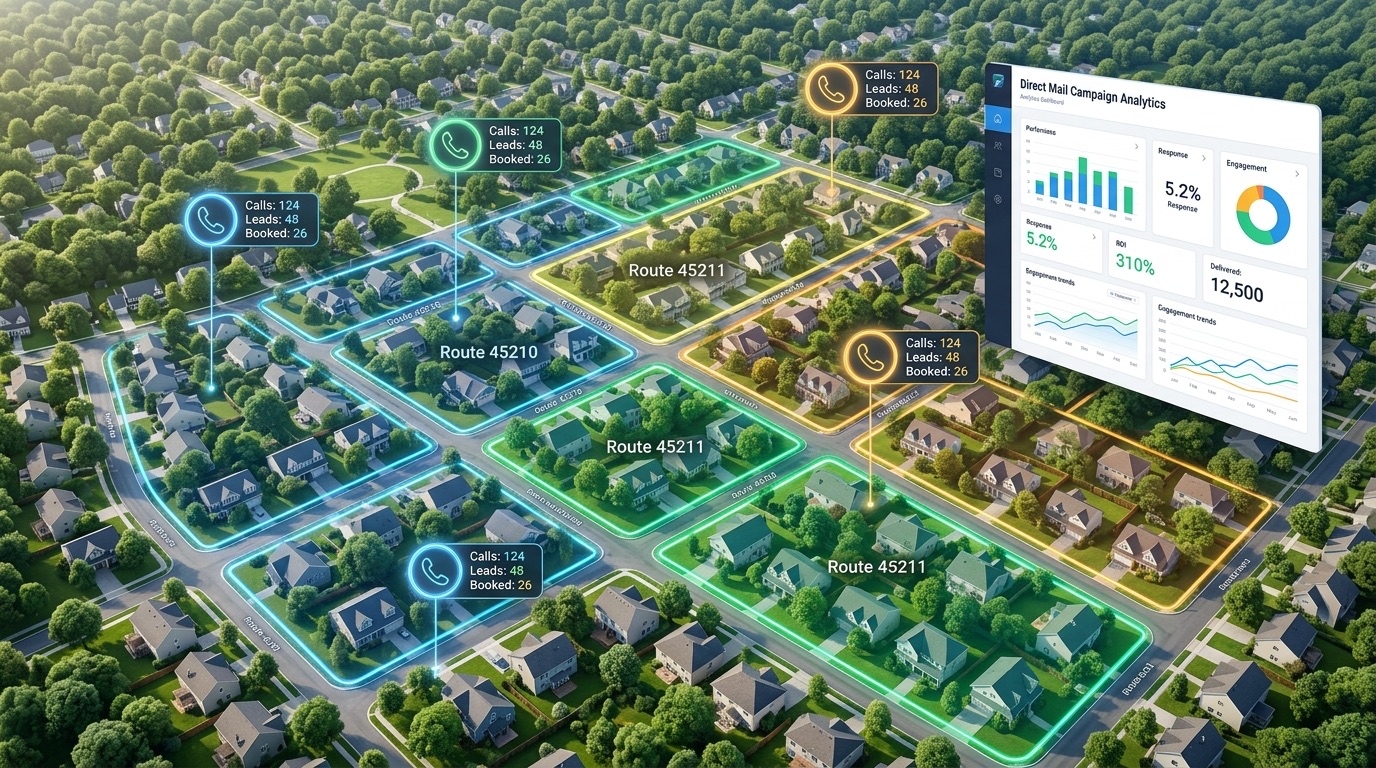
The concept is simple. Instead of one number on your letter, every carrier route gets its own unique local-area-code phone number. A typical campaign might have 40 or 50 separate numbers, all forwarding to your main business line.
You answer the phone the exact same way. Your customers notice nothing different. The homeowner calls the number on the letter, it rings your phone, you pick up. No difference in their experience.
But on your dashboard, every call is tied to the exact neighborhood it came from. Not the zip code. The carrier route. You can see that Route 47 in the Oak Hills subdivision generated 8 calls this month while Route 22 across the highway generated zero. That’s the kind of specificity that lets you make smart decisions with your budget.
Knowing which routes produce and which don’t is just the starting point. Here’s where it gets interesting.
Cut the dead weight and reinvest. This is the obvious move. If 10 of your 40 routes are generating zero calls after two months, stop mailing them. Take that budget ($400-$600 per month you were burning) and put it into your top performers or test adjacent routes with similar characteristics. Your total spend doesn’t change. Your results get better.
Cluster your estimates geographically. Our data shows high-performing routes tend to cluster in the same neighborhoods. Your best areas are usually near each other. Once you identify them, you can expand into adjacent routes and your estimator starts running 4-5 bids in the same area instead of driving across town. Matt Morovic with Upright Tree Care does 5 estimates in 2 hours because his leads are all in the same part of town. That’s not an accident. That’s route-level data at work.
Catch delivery problems before they cost you real money. If a cluster of routes suddenly shows zero calls when surrounding routes are performing normally, something went wrong at the post office. Mail gets set aside, bundles get skipped, carriers have bad days. It happens more than anyone likes to admit. We contact USPS directly to verify delivery when the data looks off. Without route-level tracking, you’d never know those 500 letters didn’t make it. You’d just wonder why the phone went quiet.
A/B test your creative with real data. Testing a new headline? A different letter design? Route-level tracking lets you split your routes and measure which version actually drives more calls. Not opinions. Not “I think this one looks better.” Actual call data from actual homeowners in actual neighborhoods. Industry data shows even a 10% lift in response rate from a winning creative test compounds into a meaningful revenue difference over 6-12 months of mail. That’s how you make decisions.
Once you can see per-route numbers, the obvious next question is what counts as good. Most published benchmarks will mislead you here, so let’s be precise.
The 2025 ANA/DMA Response Rate Report puts average direct mail response at 4.4%, with house lists (people who already bought from you) running 5-9% and prospect lists landing between 2% and 4.4%. Those figures cover every industry mailing every format, and a big share of that volume is addressed mail to a purchased list with an offer attached.
Saturation mail to a carrier route is a different animal. You’re reaching every mailbox on the street, including renters, condos, and homeowners with no trees. A tree service EDDM route that produces calls on 0.5% to 1% of the pieces mailed is performing normally, and the top routes in a well-targeted campaign run above that.
Here’s why that distinction matters at the route level. On a 700-piece carrier route, the gap between a 0.4% route and a 1.1% route is about 3 calls versus 8 calls in a month. Same postage, same printing, same design, roughly double the work.
Now stack it. If 12 of your 40 routes sit at the bottom of that range and you can’t see it, you’re funding the low half of a spread you don’t know exists. That’s the entire argument for tracking at the route level instead of the campaign level.
One more 2026 number worth putting on your spreadsheet: USPS raised EDDM postage to $0.260 per piece on July 12, 2026, up from $0.247. Postage on a dead route costs more this year than it did last year, and it will cost more next year.
Honest answer: it’s expensive and complicated to build.
Managing 40-50 individual phone numbers per client, routing them all correctly, building a dashboard that presents the data clearly, and then having a real person (not a bot, not an automated report) review that data and make optimization decisions every month? That requires infrastructure and headcount that a print-and-mail shop doesn’t have.
Tree Leads Today won’t even tell you what they’re mailing or where they’re mailing it. You pay $85 per call and hope for the best. If you leave, your phone numbers stay with them. All that call data? Gone.
DIY EDDM? You’re bundling mail at the kitchen table, driving to the post office, dealing with USPS compliance paperwork, and hoping someone calls. There’s no tracking, no feedback loop, and your results stay flat because you have zero data to improve from. It’s the cheapest option per piece, but the most expensive option when you factor in your time and the waste.
Here’s what happens when you actually use the data. This is the part that changes the math on direct mail.
Month 1: You mail 40 routes. Calls come in. Now you have a baseline. Which routes generated calls? Which ones didn’t? You’re learning.
Month 2: You cut the 10 worst routes. Reallocate that budget to your top performers or test new adjacent routes that match the profile. Your cost per call drops because you’re not paying for dead routes anymore.
Month 3: More data. More cuts. More concentration on what works. Response rates are measurably higher than month 1 because every letter is going to a neighborhood with proven potential.
Month 6: You’re mailing fewer routes than you started with, spending roughly the same amount, and generating significantly more calls. Six months of real data has sharpened your campaign from a shotgun into a rifle.
Lars Kangas with Kangas Tree Service saw this firsthand. He quoted $76K and closed $61K in his first six weeks. But here’s what most people miss about why his numbers were that strong. It wasn’t just the letter design or the neighborhoods. It’s that every route had its own tracking number. After month one, we knew exactly where the calls were coming from. Month two, we cut the dead routes and doubled down on the winners. His cost per lead dropped. His call volume went up. And he didn’t change a single thing about how he answers the phone or runs estimates.
That’s the difference between sending mail and running a direct mail system. One stays flat. The other compounds.
Dayde Collins with Blades Tree Removal in Provo quoted $47K in his first 30 days and closed $25K. He told us Tree Traction outperformed every other marketing channel and agency he’d tried. But month 1 was just the starting point. By month 3, his route data was sharp enough to predict which neighborhoods would produce before the mail even dropped.
That’s the real value of route-level tracking. Not just better results this month. A system that gets smarter every month you run it. Every campaign you do makes the next one more efficient. Your data is an asset that appreciates over time. And unlike Google or Angi, you own all of it.
Every month you mail without route-level tracking is a month you’re paying for data and throwing it away. That data compounds in value over time. The sooner you start collecting it, the sooner your results start climbing instead of flatlines.
You’ve got two options. Build the tracking yourself through CallRail or Twilio (doable, but it’s a second job on top of running your tree business, and you still have to do all the analysis yourself every month). Or work with a provider that’s already built the infrastructure across 250+ tree service companies and can often predict which routes will perform in your market before your first letter goes out. We’ve seen enough campaigns in enough markets to recognize patterns that aren’t visible after just one or two months of data. That head start matters when you’re making decisions about where to spend $3,200 a month.
Want to see which routes make sense in your area? We’ll map it out, free.
Ready to grow into the neighborhoods you want?
250+ tree companies use Tree Traction. See if your zip code is available.
Book a Free Strategy CallFREQUENTLY ASKED QUESTIONS
Instead of one tracking number on all your mail, you assign a unique local phone number to each carrier route you're mailing. All numbers forward to your main line. You answer the phone the same way. But now every call is tied to the exact neighborhood it came from, so you know which routes produce and which ones don't.
Across 250+ tree service campaigns, the pattern is consistent: roughly 75% of calls come from just 50% of routes mailed. Without route-level tracking, you can't identify which half is producing, so you keep paying for the dead routes month after month.
Technically, yes. You can buy numbers through CallRail or Twilio, assign them to routes manually, and build your own analysis. But managing 40-50 numbers per campaign, building dashboards, and actually using the data for monthly optimization adds serious complexity. Tree Traction has this built into every client campaign.
Most clients see measurable improvement by month 2-3 after cutting underperformers. By month 6, you're typically generating more calls while spending the same amount, because six months of data has sharpened your targeting.
A zip code might contain 20-30 carrier routes. Some produce great calls, others produce nothing. Zip-level tracking tells you a call came from 'somewhere in 84043.' Route-level tracking tells you exactly which neighborhood, which streets, which cluster of homes. That specificity is what lets you cut waste and scale winners.
About the Author
Brayden Fielding
CEO, Tree Traction
Brayden Fielding is the founder and CEO of Tree Traction, the only direct mail company in the U.S. built exclusively for tree service businesses. He's worked with 250+ tree service companies across the country, studying what makes direct mail campaigns produce real revenue (and what makes them flop). When he's not digging into route-level data or reviewing campaign results, he's talking to tree service owners about what's actually working in their markets.
KEEP READING
Out-of-town storm chasers flood your market after every big blow. Here is how a local tree service wins those storm leads on trust, speed, and timing.
AI search is how homeowners find contractors now. What ChatGPT reads before it names a tree service, and the trust signals worth fixing this month.
A tree service keywords guide built on real 2026 cost-per-click data: what each search term is worth, what it actually books, and where it belongs.
Book a free strategy call — 30 minutes, no obligation.
Book a Free Strategy Call