
Strategy 11 min March 30, 2026 Updated August 28, 2026
EDDM vs Targeted Direct Mail for Tree Services: What's the Difference?

Brayden Fielding
CEO, Tree Traction
Brayden Fielding
CEO, Tree Traction
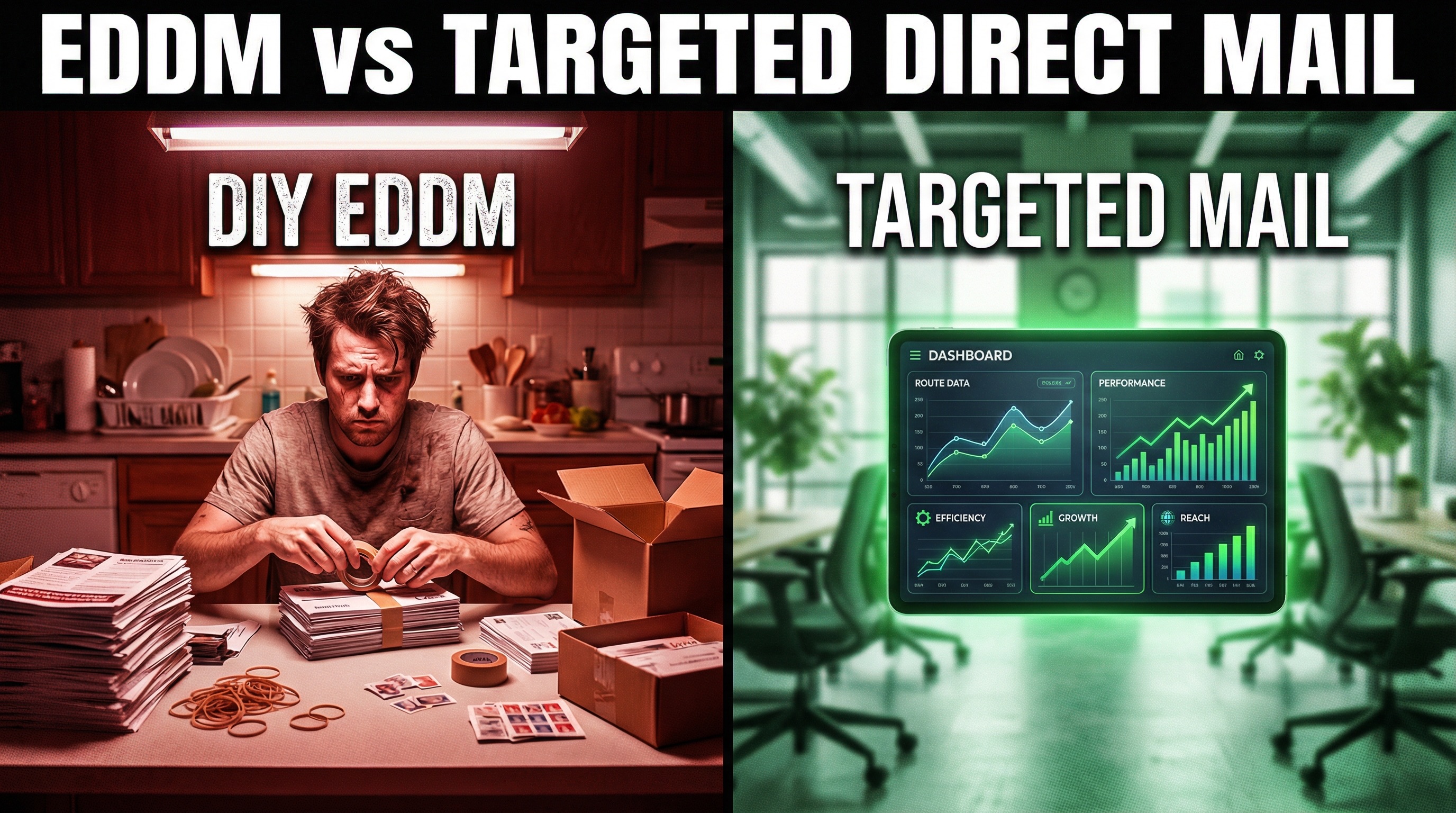
You can do your own EDDM for $0.35-$0.55 per piece. That’s a fact. And if cost per piece is the only number you care about, you should stop reading right now and head to the USPS EDDM portal.
But if you care about cost per booked job (which is the number that actually hits your bank account), keep going. Because the gap between EDDM and targeted direct mail isn’t the postage rate. It’s everything that happens after the mail lands.
We’ve run direct mail campaigns for over 250 tree service companies. We’ve seen owners do DIY EDDM, switch to targeted mail, and watch their cost per job drop even though their cost per piece went up. That math sounds backward until you understand what’s really going on.
EDDM stands for Every Door Direct Mail. It’s a USPS program that lets you mail to every single address on a carrier route without buying a mailing list. You go to the USPS EDDM portal, pick your routes on a map, print your mailers, bundle them according to USPS specs, and drop them at the post office.
Postage is $0.26 per piece under the USPS EDDM Retail program, up from $0.247 after the July 2026 rate adjustment. USPS also caps EDDM Retail at 5,000 pieces per day per ZIP code. Add printing and you’re looking at $0.35-$0.55 all-in depending on quantity and paper stock.
That’s genuinely cheap. And for a tree service owner who wants to get mailers into mailboxes on a budget, it’s a real option. No one should pretend otherwise.
But here’s what EDDM is not: a marketing system. It’s a delivery mechanism. EDDM gets paper from Point A to Point B. It doesn’t tell you which routes produced calls. It doesn’t tell you which mailer design worked better. It doesn’t tell you whether the mail was even delivered (EDDM is lowest-priority mail, and USPS carriers sometimes skip routes or deliver late). And it doesn’t get better over time.
That last part is the one that costs you the most money.
Before you decide anything, run the numbers on the program itself. We walked through whether EDDM is worth it for a tree service line by line: current USPS postage, what a self-run drop really costs once your own hours are counted, and how the cost per booked job moves when routes are picked by eye instead of by data.
Targeted direct mail uses the same USPS EDDM delivery system. Your mailers still go to every door on a carrier route. The postage is the same. The mailbox is the same.
The difference is everything that wraps around that delivery. Here’s what a targeted approach (like what we do at Tree Traction) adds:
Route-level call tracking. Every carrier route gets its own unique tracking phone number. A single client might have 40-50 numbers, all forwarding to their main line. When someone calls, you know exactly which neighborhood produced that lead.
Satellite tree density data. We analyze tree canopy coverage, property size, and vegetation health per carrier route using satellite imagery. We’re the only company in the U.S. with tree density data at the carrier route level. That means your mailers go to neighborhoods where homeowners actually have trees that need work.
295 data points per route. Income, home value, homeowner age, property size, tree density, and more. This isn’t guessing. It’s picking routes based on data that predicts where tree service calls come from.
A/B creative testing. Different mailer designs go to different routes. Maybe a selfie-style photo outperforms a professional crew shot in your market. Maybe a storm damage headline beats a spring cleanup angle. You won’t know unless you test, and you can’t test without tracking.
Monthly optimization. After every mailing, underperforming routes get cut. Winners get scaled. Your campaign gets sharper every month instead of staying flat.
Sound familiar? That “cut what’s not working, scale what is” approach is exactly how you’d expect any professional marketing channel to operate. Google Ads does it. Facebook does it. But most tree service owners doing DIY EDDM never get that feedback loop. They just keep mailing the same routes month after month, hoping for the best.
The useful comparison is not postage alone, but what each model lets you control after the first drop.
| Decision factor | DIY EDDM | Targeted direct mail |
|---|---|---|
| Addresses reached | Every residential address on selected routes | Routes selected for likely tree-service demand |
| Data used before mailing | Basic route counts and demographics | 295 data points per carrier route |
| Call attribution | Usually one number for the whole drop | Unique number for each carrier route |
| Budget changes after a drop | Manual guesswork | Cut weak routes and test replacements |
| Best fit | Broad local saturation | Ongoing, measurable customer acquisition |
Let’s put the numbers side by side. No spin.
DIY EDDM:
Targeted direct mail (Tree Traction):
Yes, targeted mail costs more per piece. About $0.15-$0.20 more. On a 2,300-piece mailing, that’s roughly $350-$460 extra. That’s the gap everyone focuses on.
But here’s the question nobody asks: what’s the cost per booked job?
Let’s say you send 5,000 EDDM pieces at $0.45 each. That’s $2,250. You get 15 calls (a 0.3% response rate, which is typical for untargeted EDDM). You close 5 jobs. Your cost per booked job is $450.
Now let’s say you send 4,600 targeted pieces at $0.65 each. That’s $2,990. You get 25 calls because your routes were selected using tree density data, income filters, and historical performance. You close 10 jobs. Your cost per booked job is $299.
You paid more per piece but less per job. And those 10 jobs are clustered in the same neighborhoods, so your crew runs estimates back to back instead of driving 45 minutes between bids. That’s the part that doesn’t show up on any invoice but changes your entire day.
Matt Morovic with Upright Tree Care in Wisconsin does 5 estimates in 2 hours because his calls come from the same neighborhoods. He 10x’d his marketing spend in his first month. His cost per piece was higher than DIY. His cost per job was a fraction of what he’d been paying before.
Here’s what actually happens when you do DIY EDDM for six months versus running a tracked, targeted campaign.
DIY EDDM over 6 months: You mail the same routes (because you picked them once and stuck with them). You use the same design (because redesigning takes time you don’t have). Your response rate stays between 0.2% and 0.5%. Maybe you get 10-15 calls per mailing. Some months are good, some are dead. You have no idea why. After six months you’ve spent about $13,500 and you’re getting the same results you got in month one.
Targeted direct mail over 6 months: Month one, you mail 20 routes. Your tracking data shows 75% of your calls came from 10 of those routes. Month two, you cut the bottom 10 and test 10 new ones. By month three, you’ve identified your top-performing neighborhoods. By month six, every dollar goes to routes with proven call history. Your response rate has climbed. Your cost per job has dropped. And you have a heat map showing exactly where tree service demand lives in your market.
That compounding effect is the entire point. It’s the difference between sending mail and running a direct mail system.
Alissa Tooley with A&J Specialties saw it firsthand. She quoted $160,800 in her first 3 months and closed $69,200. Her results got better each month because her campaign got smarter each month. That doesn’t happen with DIY EDDM. It can’t, because there’s no data to learn from.
The $0.35-$0.55 per piece number is real. But it leaves out a few things.
Your time. Selecting routes on the USPS portal takes hours. Designing a mailer (or coordinating with a printer) takes hours. Bundling mail by carrier route to meet USPS’s bundling requirements takes hours. Driving to the post office (sometimes multiple locations) takes hours. For a tree service owner billing $100-$200/hour in the field, those 5-10 hours per mailing aren’t free. They’re the most expensive part of the whole operation.
Delivery uncertainty. EDDM is the lowest-priority class of mail. Carriers sometimes delay delivery by days or weeks. Sometimes bundles get set aside and never delivered. You’d never know because there’s no tracking. At Tree Traction, if a cluster of adjacent routes shows zero calls, our team contacts the post office directly to verify delivery. DIY mailers just hope for the best.
Flat results. This is the big one. Without per-route tracking, you can’t tell which neighborhoods work and which don’t. So you keep spending money on dead routes. Our internal data across 250+ tree service companies shows that roughly 75% of calls come from just 50% of routes mailed. That means half your DIY budget is producing almost nothing, and you’ll never know which half.
Let’s be honest. DIY EDDM isn’t always the wrong move. If you’re a new one-truck tree service doing under $300K in revenue and you genuinely can’t afford $1,800-$3,200 a month for professional direct mail, doing your own EDDM is better than doing nothing. Getting mailers into mailboxes at $0.40 a piece beats sitting around waiting for the phone to ring.
But treat it as a starting point, not a long-term strategy. The moment your revenue supports it, the jump to tracked, targeted mail pays for itself through better route selection and lower cost per job. Every month you spend mailing blind is a month where your results stay flat while your competitors’ results improve.
And if you’re already doing $750K or more? You’re past the point where DIY makes sense. Your time in the field is worth too much, and the lack of tracking data is costing you more than the per-piece savings.
Not all “targeted” providers are created equal. If you’re shopping for a direct mail partner for your tree service, here are the things that actually matter:
Route-level tracking, not zip-code-level. Some providers track by zip code. That’s useless. A single zip code can have 30-50 carrier routes, and most of them won’t produce calls. You need a unique phone number on every route so you know exactly which neighborhoods drive results. (Learn more about why route tracking matters.)
You own the data. If you leave, your phone numbers, call history, and route performance data should leave with you. Some providers (like Tree Leads Today) own the tracking number. Walk away, and you start from zero.
Real targeting data, not just demographics. Income and home value matter, but for tree services, tree density is the most important variable. If a carrier route has no trees, it doesn’t matter how wealthy the homeowners are. They don’t need a tree service. Ask your provider if they have tree density data per route. If they don’t, they’re guessing.
Monthly optimization is non-negotiable. If your provider sends the same mail to the same routes every month without adjusting based on results, you’re paying for a printing service, not a marketing partner.
One more number worth knowing. The 2025 ANA/DMA Response Rate Report reports the average direct mail response rate across all industries at 4.4%. Tree service campaigns run lower on raw response rate (0.5% to 1% is typical) because you’re targeting a very specific need, not mass-market offers. But the economics can still work when the targeting is right, because a single booked removal at $2,500 covers most of a monthly campaign.
DIY EDDM costs less per piece. That’s true, and we won’t pretend it isn’t. If someone tells you targeted direct mail is cheaper per piece than doing it yourself, they’re lying.
But cost per piece is a vanity metric for tree service companies. The metrics that matter are cost per call, cost per booked job, and revenue per dollar spent. And on every one of those, tracked and targeted direct mail wins. Not because the paper is different or the mailbox is different. Because the data behind it turns a one-time expense into a compounding investment.
Lars Kangas with Kangas Tree Service quoted $76K and closed $61K in his first six weeks with targeted direct mail. He’d been skeptical. But the route-level tracking showed him exactly where his calls were coming from, and his account manager cut the dead routes and doubled down on the winners. That’s not something you get from the USPS EDDM portal.
Want to see which carrier routes in your area have the highest tree density and best demographics for your tree service? We’ll map it out for free.
Your move.
Ready to grow into the neighborhoods you want?
250+ tree companies use Tree Traction. See if your zip code is available.
Book a Free Strategy CallFREQUENTLY ASKED QUESTIONS
EDDM (Every Door Direct Mail) is a USPS program that lets you mail to every address on a carrier route without needing a mailing list. You select routes through the USPS EDDM portal, print your mailers, bundle them by route, and drop them at the post office. USPS charges $0.26 per piece for EDDM Retail as of July 2026, with total all-in costs of $0.35-$0.55 including printing.
On a per-piece basis, yes. DIY EDDM costs $0.35-$0.55 per piece versus $0.52-$0.70 with a targeted provider like Tree Traction. But without route-level call tracking, you can't identify which routes produce calls and which waste money. That means your cost per booked job often ends up higher, not lower.
Targeted direct mail adds route-level call tracking with unique phone numbers per carrier route, satellite tree density data, demographic analysis using 295 data points, A/B creative testing, and monthly optimization that cuts underperforming routes. These tools create a feedback loop that improves results month over month.
Generic EDDM campaigns average a 0.5-2% response rate. Targeted direct mail with route-level optimization typically hits 0.5-1% in month one but improves over time as underperforming routes get cut and winners get scaled. By month three or four, response rates are meaningfully higher than where they started.
If you have 5-10 hours a week to select routes, design mailers, bundle mail, make post office runs, and track results manually, DIY EDDM can work as a starting point. But most tree service owners doing $750K+ find the time cost alone makes it impractical. The bigger issue is the lack of tracking, which means results never improve.
About the Author
Brayden Fielding
CEO, Tree Traction
Brayden Fielding is the founder and CEO of Tree Traction, the only direct mail company in the U.S. built exclusively for tree service businesses. He's worked with 250+ tree service companies across the country, studying what makes direct mail campaigns produce real revenue (and what makes them flop). When he's not digging into route-level data or reviewing campaign results, he's talking to tree service owners about what's actually working in their markets.
KEEP READING
Out-of-town storm chasers flood your market after every big blow. Here is how a local tree service wins those storm leads on trust, speed, and timing.
AI search is how homeowners find contractors now. What ChatGPT reads before it names a tree service, and the trust signals worth fixing this month.
A tree service keywords guide built on real 2026 cost-per-click data: what each search term is worth, what it actually books, and where it belongs.
Book a free strategy call — 30 minutes, no obligation.
Book a Free Strategy Call