
Strategy 10 min March 1, 2026 Updated August 11, 2026
Tree Service Direct Mail vs. Google LSA: 2026 Comparison

Brayden Fielding
CEO, Tree Traction
Brayden Fielding
CEO, Tree Traction
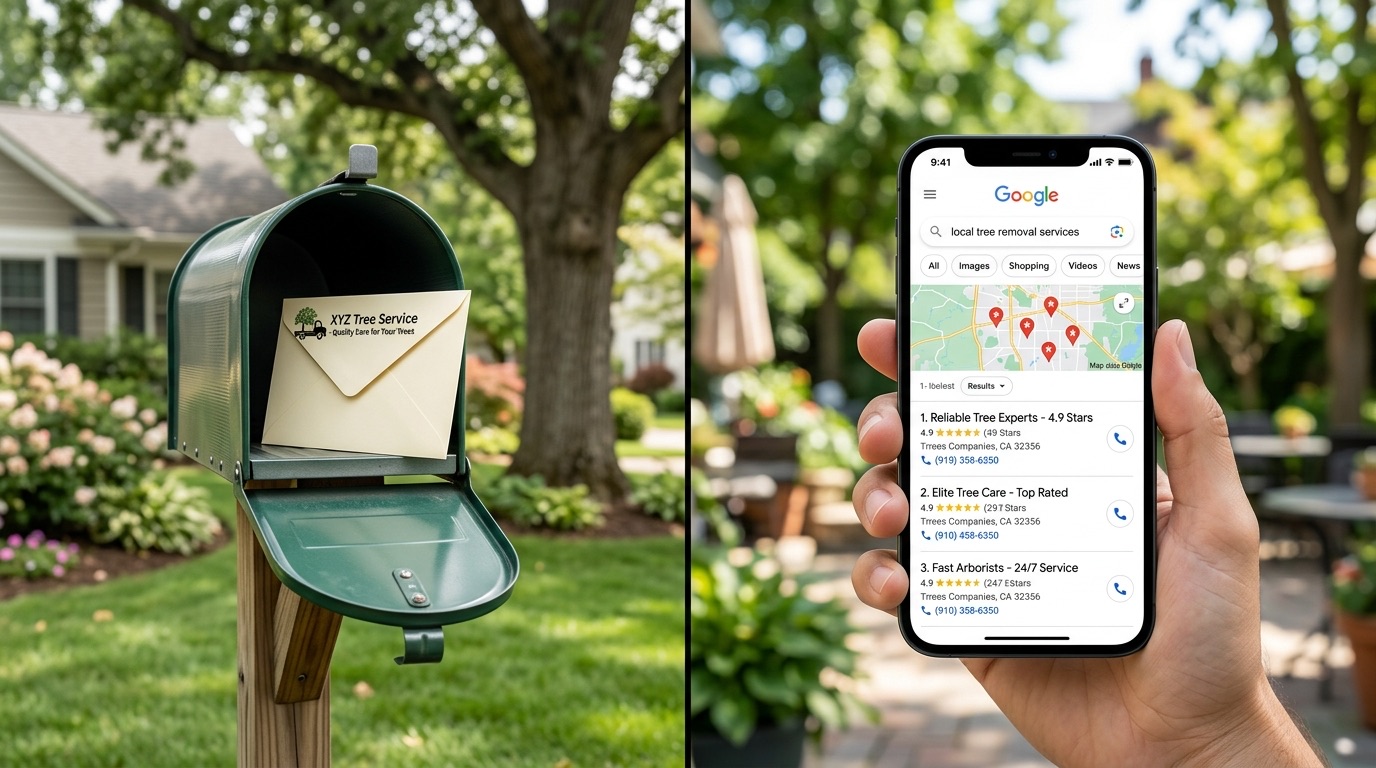
Every tree service marketing “expert” will tell you Google LSA is the best lead source in 2026. Highest intent. Google Guaranteed badge. Just turn it on and leads come in.
They’re not wrong about the intent part. But they’re leaving out about five things that matter more.
After seeing the data from 250+ tree service direct mail campaigns side by side with what our clients report from their Google LSA accounts, the picture looks a lot different than the one Google’s selling. Let’s break it down. No BS, just the math and the mechanics.
Google LSA wins on raw intent. No question. Someone searched “tree removal near me,” found your listing, and called. They need a tree taken down. That’s real purchase intent.
But here’s what changed. Google rolled out “Get Competitive Quotes” in late 2025, and now a single homeowner’s request gets routed to up to four tree services at the same time. Each company gets charged for the same lead. What used to be an exclusive call is now a shared lead, and you’re paying $65-$95 for the privilege of competing against three other tree companies before anyone picks up the phone. The feature started rolling out broadly across tree care in September 2025 and is now widespread. By the time you call back, they’ve already talked to two other companies and they’re comparing prices.
Sound familiar? That’s the same problem you had with Angi. High intent, shared lead, price war.
Direct mail works differently. The homeowner hasn’t searched for anything. They got your letter in the mail, liked what they saw, and called you. Not Google. Not a directory. You. They haven’t spoken to your competitors. They’re not comparing four quotes. You set the frame for the entire conversation.
Alissa Tooley with A&J Specialties quoted $160,800 in her first three months on direct mail and closed $69,200. Her calls came from homeowners who’d received her letter, not homeowners who were shopping five companies on Google. The conversations were different from the first sentence.
Google wins on intent. Mail wins on exclusivity. And in our experience across 250+ tree service companies, exclusivity closes at higher rates and higher average job values.
This one isn’t close.
Google LSA charges per lead. Tree service CPLs in competitive markets were already running $50 to $150. That number has climbed roughly 40% since 2023 in high-competition markets, with many tree services now seeing $65 to $95 per lead in metro areas. And it changes week to week based on how many other companies are bidding in your area. A new competitor enters your market? Your CPL spikes. Google changes the algorithm? Your volume drops. Since Google killed manual lead dispute in 2024, you’re paying for every call, whether it was a real prospect or someone asking about “that branch near the power line” (utility company’s problem, not yours). In 2025 Google also stopped issuing credits for “job type not serviced” and “geo not serviced” leads if your category and location settings aren’t dialed in tight. Two-thirds of contractors surveyed in early 2026 said LSA lead quality is declining. Two-thirds.
There’s now a public number to anchor against. One agency dataset covering $6.72 million in LSA spend across 888 contractors put the average home services lead at roughly $53 as of February 2026. Tree service sits above that average in most metros, because job values are high and every company in town knows it.
Here’s the part that stings. The lead dispute process that used to refund a bad lead inside 48 hours now routinely drags on for weeks, so the money leaves your account long before anyone reviews whether the call was real tree work or a neighbor asking who owns the branch over the fence.
Direct mail costs $0.52 to $0.70 per letter, depending on volume. You mail 4,600 letters, you know exactly what you’re spending before the month starts. No algorithm decides your cost. No competitor can outbid you and spike your rates overnight.
Say your LSA budget averages $3,800 a month, but the bill swings by $1,000. One month lands at $3,200 and the next at $4,500, with no clear reason. A fixed direct mail spend lets you plan your crew schedule, cash flow, and growth around the same number every month.
Ben Howard with Howard Tree Care in Denver nearly 4x’d his investment from his direct mail campaign. At a fixed cost per piece, he knew his ROI before the month was over. That’s the kind of math you can build a business on.
Google LSA: You control your budget cap. That’s about it. Google decides when your ad shows, who sees it, which neighborhoods the lead comes from, and whether your account stays active tomorrow. You’re renting space on someone else’s platform, and they can change the rules whenever they want.
You can’t choose to only show up in the wealthy subdivision with the big oaks. Google shows you wherever Google decides. Metro-level targeting, not neighborhood-level.
Direct mail: You pick the exact carrier routes. You approve the letter design. You choose the drop date. You decide how many pieces go out. No algorithm. No black box. No middleman between your letter and the homeowner’s mailbox.
With Tree Traction, you’re selecting from 295 data points per carrier route, including satellite tree density analysis. Want to target the high-income subdivision with mature oaks and half-acre lots? You can. Want to avoid the condo development across the highway with zero trees? Done. That level of control doesn’t exist on any digital platform.
Let’s be direct about this. When you build your business on Google’s platform, Google owns the relationship. And they can pull the rug out anytime.
We’ve talked to tree service owners who woke up one morning with their LSA account suspended. No warning. No explanation that made sense. Leads stopped overnight. Their phone went silent. One guy lost $15K in potential jobs in the two weeks it took to get reinstated. Another never got reinstated and had to start his entire online presence from scratch.
Your reviews? On Google’s platform. Your lead history? In Google’s database. Your ranking? Determined by Google’s algorithm, which changes on Google’s timeline, for Google’s benefit.
Stop paying and everything you built disappears. Every review, every call, every dollar you invested in building your Google presence. Gone.
With direct mail (the way we do it), your tracking numbers are yours. Your call history is yours. Your route performance data is yours. Walk away and you keep everything you built. Port your numbers out for $1.25 each. The brand recognition you’ve built in those neighborhoods by mailing consistently for 6 months? That doesn’t vanish because you stopped writing a check to a vendor.
That’s the difference between building an asset and renting a storefront on someone else’s land.
Google LSA scales up to the ceiling of local search volume. Once everyone in your area who’s searching for tree service has seen your ad, you’ve maxed out. There’s no more demand to capture. You’re fighting over a fixed pie with every other tree service in town.
Direct mail creates demand that didn’t exist before. The homeowner wasn’t searching. They weren’t thinking about their trees. Then your letter showed up, and now they’re calling about that dead oak in the backyard they’ve been meaning to deal with for two years. You created that call. Google can’t do that.
Volume is limited only by your service area. Tree Traction clients have scaled from 4,600 letters a month to 50,000+. Carlos Morales with JC Tree Care in New Mexico quoted $40,600 in his first week. That’s demand creation, not demand capture.
The two channels work best when each has a defined role and a separate scorecard.
| Decision factor | Google LSA | Targeted direct mail |
|---|---|---|
| Primary role | Capture homeowners already searching | Create calls in selected neighborhoods |
| Payment model | Pay per call or qualifying contact | $0.52-$0.70 per letter |
| Competitive setting | Several providers appear together | The letter presents one tree company |
| Targeting control | Service area and Google eligibility | Carrier routes scored on 295 data points |
| Performance data | Platform account history | Route-level call history and owned numbers |
| Best budget use | Immediate demand capture | Repeatable neighborhood penetration |
Let’s be honest. The best tree service marketing in 2026 uses both channels.
Google LSA catches the homeowner who’s already searching right now. Direct mail reaches the homeowner who hasn’t searched yet but will next month when your letter’s been sitting on their kitchen counter. Together, your call volume is more consistent because the two channels respond to completely different variables.
Google search volume drops in winter. People aren’t Googling “tree trimming” in January. But dormant pruning season? Your letter in the right mailbox generates calls all winter. Ricky Folse with Veteran Tree Care got 10 calls in 2 days during the slowest season on his first mail drop. Google LSA didn’t do that for him.
But if you had to pick one? If you’re in a competitive market where CPLs keep climbing and Google keeps changing the rules?
Direct mail is the more reliable foundation. Predictable costs. Exclusive leads. Route-level data that compounds over time. Geographic clustering that makes your whole operation more efficient. And you own everything you build.
Google’s “Get Competitive Quotes” turned LSA from exclusive calls into shared leads, and the rollout across tree care was complete by late 2025. That’s a fundamental change to the value of the channel. If you’re paying $80 per lead and that lead is talking to three other companies at the same moment, your effective cost per booked job didn’t double. It tripled or worse, depending on your close rate. And the credit system that used to offset bad leads? Gone for job-type and geo mismatches since 2025.
The Google Guaranteed badge is gone. In October 2025 Google retired the green “Google Guaranteed” badge and replaced it with a plain blue “Google Verified” badge. The $2,000 money-back guarantee that homeowners actually recognized went away with it. If part of your LSA pitch was “look, Google backs my work,” that talking point no longer exists.
LSA is being folded into Google Ads. The migration started with a slice of U.S. advertisers in August 2026 and runs through 2027. The billing model stays pay-per-lead, but tree service owners who finally got comfortable with the standalone LSA dashboard get to relearn the whole thing inside a far more complicated ad platform.
Google killed the LSA mobile app in January 2025. Campaign management got harder, not easier. More time in front of a computer for a tree service owner who’s supposed to be running estimates and managing crews.
Facebook lead quality cratered in 2024-2025. AI-optimized campaigns drove costs up and quality down across home services. Tire kickers, free-wood seekers, and people who forgot they filled out a form. Most tree service owners we talk to have given up on Facebook entirely.
Direct mail response rates are holding steady. Less total mail volume means less competition in the mailbox. Your letter stands out more now than it did five years ago. And with Vericast’s 2024 Direct Mail Influence Report found 58% of consumers say direct mail is trustworthy, the format itself carries credibility that an online ad doesn’t.
Want to see what direct mail would look like in your market? We’ll run the numbers with you, free, no pitch. Or read the full side-by-side comparison of Tree Traction vs. Google LSA for every detail.
Ready to grow into the neighborhoods you want?
250+ tree companies use Tree Traction. See if your zip code is available.
Book a Free Strategy CallFREQUENTLY ASKED QUESTIONS
They do different things. Google LSA captures people already searching (high intent, but shared and expensive at $50-$150/lead). Direct mail reaches people before they search (exclusive, predictable at $0.52-$0.70/piece). If you can only pick one in a competitive market, direct mail is more predictable and builds assets you own. Most strong tree companies run both.
Across home services, the tracked average sat around $53 per lead as of February 2026, but tree service in competitive metros runs $50-$150+ each. That number spikes without warning when competitors enter your area. And since Google killed manual lead disputes in 2024, you're paying for leads you can't contest. Direct mail costs $0.52-$0.70 per letter, fixed, every month.
Yes. Flagged license, disputed review, algorithm update, verification issue. When it happens, leads stop overnight with limited recourse. We've talked to tree service owners who lost their entire lead flow in 24 hours. Direct mail runs completely outside Google's system.
Google LSA: leads stop immediately. You built nothing. Direct mail through Tree Traction: your tracking numbers, call history, and route performance data are yours. Port your numbers for $1.25 each. The data and brand recognition you built in those neighborhoods persist.
About the Author
Brayden Fielding
CEO, Tree Traction
Brayden Fielding is the founder and CEO of Tree Traction, the only direct mail company in the U.S. built exclusively for tree service businesses. He's worked with 250+ tree service companies across the country, studying what makes direct mail campaigns produce real revenue (and what makes them flop). When he's not digging into route-level data or reviewing campaign results, he's talking to tree service owners about what's actually working in their markets.
KEEP READING
Out-of-town storm chasers flood your market after every big blow. Here is how a local tree service wins those storm leads on trust, speed, and timing.
AI search is how homeowners find contractors now. What ChatGPT reads before it names a tree service, and the trust signals worth fixing this month.
A tree service keywords guide built on real 2026 cost-per-click data: what each search term is worth, what it actually books, and where it belongs.
Book a free strategy call — 30 minutes, no obligation.
Book a Free Strategy Call