
Strategy 9 min July 1, 2026
Tree Service Profit Margins: Benchmarks and Marketing Impact

Brayden Fielding
CEO, Tree Traction
Brayden Fielding
CEO, Tree Traction
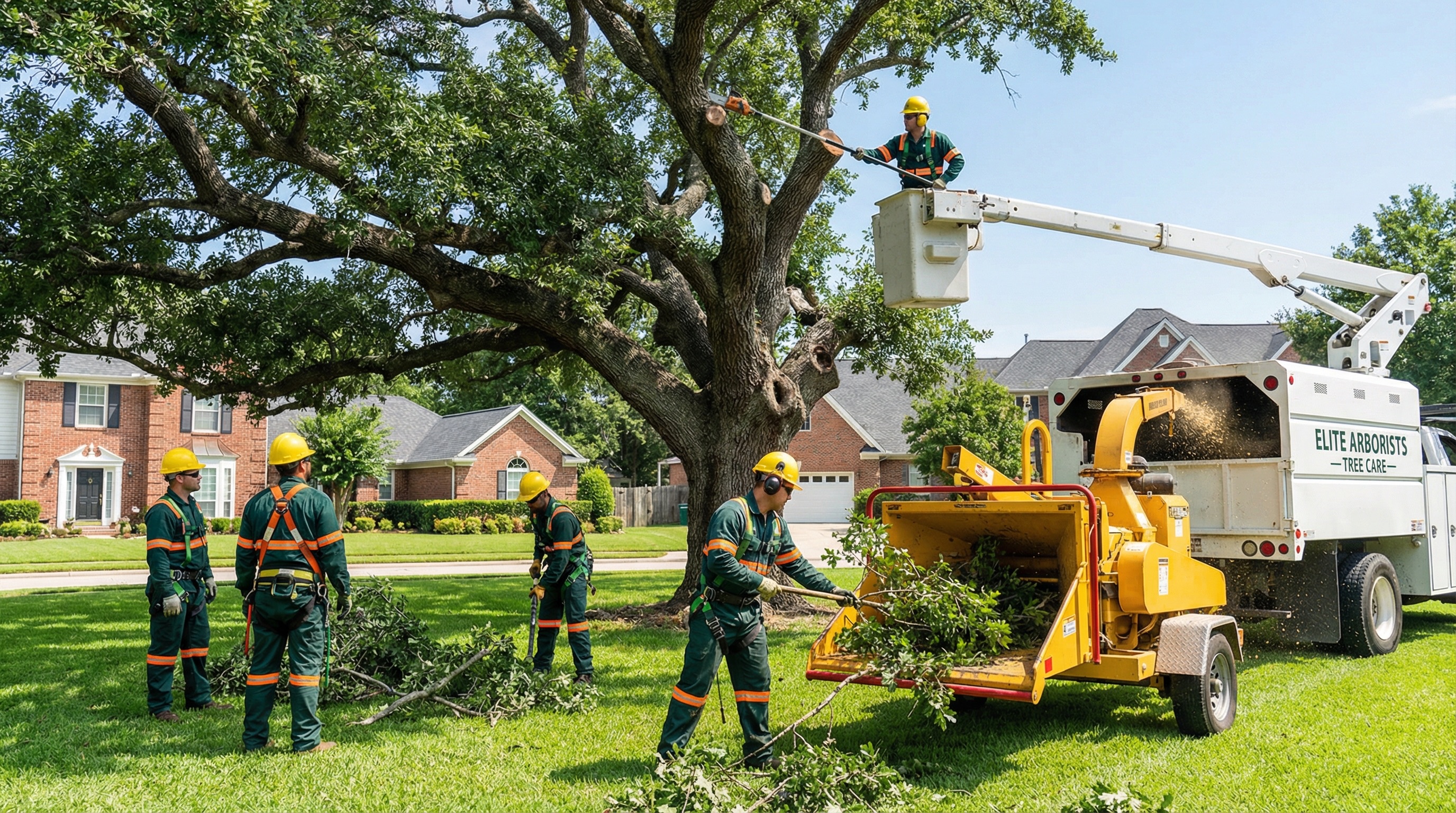
A tree service doing $900K a year can net 8% or 22% depending entirely on where the work comes from and what it costs to get it. Same trucks, same crew, same tools.
The difference is tree service profit margins.
Most owners have never actually run the numbers on their own business to know which end of that range they’re on, service line by service line, month by month. Let’s fix that.
Healthy tree service profit margins run 10-20% net, with smaller, leaner operations sometimes pushing 20-30% because they’re carrying less overhead per job. That’s the range across an industry that sits at roughly $26.0 billion in the U.S. this year according to IBISWorld.
But that range hides a lot. A removal-heavy month and a trim-heavy month can look identical on the top line and completely different on the bottom line.
Removals typically run 10-20% margin. Cranes, chippers, stump grinders, disposal fees, and the insurance premium that comes with felling a 60-foot oak next to someone’s roof all eat into the job total before you see a dollar of profit.
Plant health care and smaller pruning jobs often run 30-50% margin. Less equipment, less insurance exposure, faster turnaround per crew hour.
Storm and emergency response can hit 25-40% margin because homeowners pay a premium for someone showing up now, not next Tuesday.
If your service mix is heavy on removals and light on everything else, a 12% margin might be completely normal for your business. The mistake is comparing your number to a generic industry average without knowing what’s actually driving it.
Run the math on a typical $1,500 job and the leakage becomes obvious.
Labor eats roughly 30% of revenue on the field side alone. Insurance runs another 3-5% of revenue for most tree services, sometimes more once you factor in the per-job liability exposure on removals near structures.
Equipment costs, fuel, and maintenance typically account for 12-15% of direct costs. Add administrative overhead, software, and licensing, and you’re looking at another 10-15% before marketing even enters the picture.
Stack those and you understand why a “profitable” tree service can still be running on fumes some months. There isn’t much room left once labor, insurance, and equipment take their cut.
Which is exactly why the marketing line item matters so much for protecting your margin. It’s one of the few costs on that list you actually control month to month, unlike labor or insurance, which mostly move with the market.
Ever notice how a “good lead month” doesn’t always show up as a good month in your bank account? Here’s the part most owners get wrong. They look at their marketing spend as a single number and never break down what each channel is actually costing them per closed job, which is the number that actually determines your tree service profit margins.
Google LSA leads run $25-40 per lead in smaller markets and $80-100 per lead in competitive metros. Google Ads cost per click for home services averaged $8.33 in 2026, up double digits year over year, one of the steepest jumps since 2021. Angi and Thumbtack send that same homeowner’s request to three, four, sometimes five other companies at once.
Now do the math on margin, not just lead cost. If you’re paying $85 for a lead on Angi and competing against four other bids, your close rate drops and your price per job drops too, because the homeowner is shopping.
That $85 lead cost turns into a $250-300 real acquisition cost once you account for the deals you lose to a cheaper competitor. Compare that to a scenario where the homeowner only called you.
No bidding war. No price shopping. No split attention.
That’s not a small difference. It’s the gap between a 22% margin and an 8% one on the exact same job, and it’s a gap most owners never trace back to the marketing channel that created it.
A Growth plan with Tree Traction runs about $3,200/month for 4,600 letters across two mailings, roughly 3-5% of monthly revenue for a company doing $65K-$95K a month. At a realistic 0.6-0.9% response rate, that’s 27-41 inbound calls from homeowners who called only you.
Lars Kangas with Kangas Tree Service quoted $76,000 in jobs and closed $61,000 of it in his first six weeks. His words: “The leads are very, very serious leads and 99% of them want tree work.” No price war, no split attention, and no lead cost eating into the close before he even picked up the phone.
Dayde Collins with Blades Tree Removal in Provo quoted $47,000 in 30 days and closed $25,000, outperforming every digital channel and agency he’d tried before. That’s the acquisition side of the margin equation working in his favor instead of against it.
The second lever is drive time, and it’s the one owners underestimate the most. Matt Morovic with Upright Tree Care runs 5 estimates in 2 hours because geographic clustering puts his calls in the same neighborhood instead of scattered across the county.
Every hour your crew isn’t driving is an hour they can be on a job site. That shows up in your margin the same way a lower material cost would, except almost nobody tracks it that way.
Let’s put real numbers next to each other. Say you’re closing 40% of your calls at an average job value of $1,600.
With direct mail at $3,200/month producing 30 calls, your cost per call is about $107 and your cost per closed job is roughly $267. You keep the full margin on that job because there’s no bidding war shaving your price down.
With a pay-per-lead platform at $85/lead in a market where you’re one of four bidders, your effective cost per closed job often runs $250-350 once you factor in the lower close rate and the discount you offer to win against competitors. You’re paying a similar or higher acquisition cost and giving up margin on price at the same time.
That’s the piece that doesn’t show up in a simple cost-per-lead comparison. Route-level tracking is what lets you actually see this instead of guessing at it, because you know exactly which routes and which months are producing your best-margin jobs.
Ever wonder why your buddy’s tree service posts a better margin than yours on similar revenue?
Two tree services can post the same 15% margin and be running completely different businesses. One is doing mostly removals at high volume with thin per-job margin. The other is mixing in enough PHC and pruning work to offset a couple of low-margin removals a week.
Neither is wrong. But if you’re tracking a single company-wide margin number, you can’t tell which service lines are actually carrying the business and which ones are close to breakeven.
Pull your numbers by service line, not just by month. Your pricing strategy should reflect what each service line actually costs to deliver, not a flat markup applied across removals, trims, and stump grinds equally.
Improving your tree service profit margins isn’t usually about raising prices, though that matters too. It’s about controlling the two levers that are actually in your control: what it costs to acquire the job, and how much windshield time you burn getting to it.
Alissa Tooley with A&J Specialties pulled a consistent $40,000 a month from mailer leads alone, on top of quoting $160,800 and closing $69,200 over three months. That kind of volume, at exclusive rates with no shared leads, is what lets a business hold margin instead of bleeding it out job by job.
The tree service companies hitting 20%+ margins consistently aren’t the ones with the cheapest labor or the newest equipment. They’re the ones who know their customer acquisition cost by service line and aren’t quietly losing 10 points of margin to a lead platform that puts them in a price war every single time the phone rings.
You can’t fix a margin problem you haven’t measured. Pull your last three months of jobs, sort by service line, and figure out what removals actually net versus what your PHC and pruning work nets.
Then look at what each marketing channel actually costs you per closed job, not per lead. That single change in how you track the number is usually what separates a tree service stuck at 10% margin from one running 20%.
Most tree service owners have never done this math. The ones who have usually find their margin problem isn’t pricing. It’s acquisition cost and drive time quietly eating the difference every single month.
Want to see what your acquisition cost would look like with route-level direct mail in your market? We’ll map it out for free.
Ready to grow into the neighborhoods you want?
250+ tree companies use Tree Traction. See if your zip code is available.
Book a Free Strategy CallFREQUENTLY ASKED QUESTIONS
Most tree service companies run 10-20% net profit margins, with smaller operations often targeting 20-30% since they carry less overhead. Removals typically land at the lower end because of equipment, disposal, and insurance costs, while plant health care and emergency storm work can run 25-50% because of premium pricing and lower equipment burden.
Removal jobs carry the heaviest equipment costs, the highest insurance exposure, and disposal fees that eat straight into the job total. A trim or plant health care visit uses the same crew and truck without the crane, chipper fuel, or stump grinder wear, which is why those service lines often run 10-20 points higher margin.
A common target is 3-5% of revenue, which is roughly where a $3,200/month direct mail campaign lands for a company doing $65K-$95K in monthly revenue. Spending less usually means inconsistent call volume. Spending significantly more only makes sense if the channel is producing a customer acquisition cost well under your average job margin.
It can, mainly through two mechanisms: lower cost per call than shared-lead platforms, and geographic clustering that cuts drive time between estimates. Less windshield time per job means more billable hours per crew day, which shows up directly in your margin, not just your call volume.
Wasted drive time between scattered estimates. An hour driving to a $300 trim that doesn't close costs you the same fuel, wear, and lost crew hours as an hour driving to a $3,000 removal that does. Owners who don't track this assume their margin problem is pricing when it's really routing.
About the Author
Brayden Fielding
CEO, Tree Traction
Brayden Fielding is the founder and CEO of Tree Traction, the only direct mail company in the U.S. built exclusively for tree service businesses. He's worked with 250+ tree service companies across the country, studying what makes direct mail campaigns produce real revenue (and what makes them flop). When he's not digging into route-level data or reviewing campaign results, he's talking to tree service owners about what's actually working in their markets.
KEEP READING
Out-of-town storm chasers flood your market after every big blow. Here is how a local tree service wins those storm leads on trust, speed, and timing.
AI search is how homeowners find contractors now. What ChatGPT reads before it names a tree service, and the trust signals worth fixing this month.
A tree service keywords guide built on real 2026 cost-per-click data: what each search term is worth, what it actually books, and where it belongs.
Book a free strategy call — 30 minutes, no obligation.
Book a Free Strategy Call