
Strategy 11 min March 30, 2026 Updated August 10, 2026
What Does It Really Cost to Acquire a Tree Service Customer?

Brayden Fielding
CEO, Tree Traction
Brayden Fielding
CEO, Tree Traction
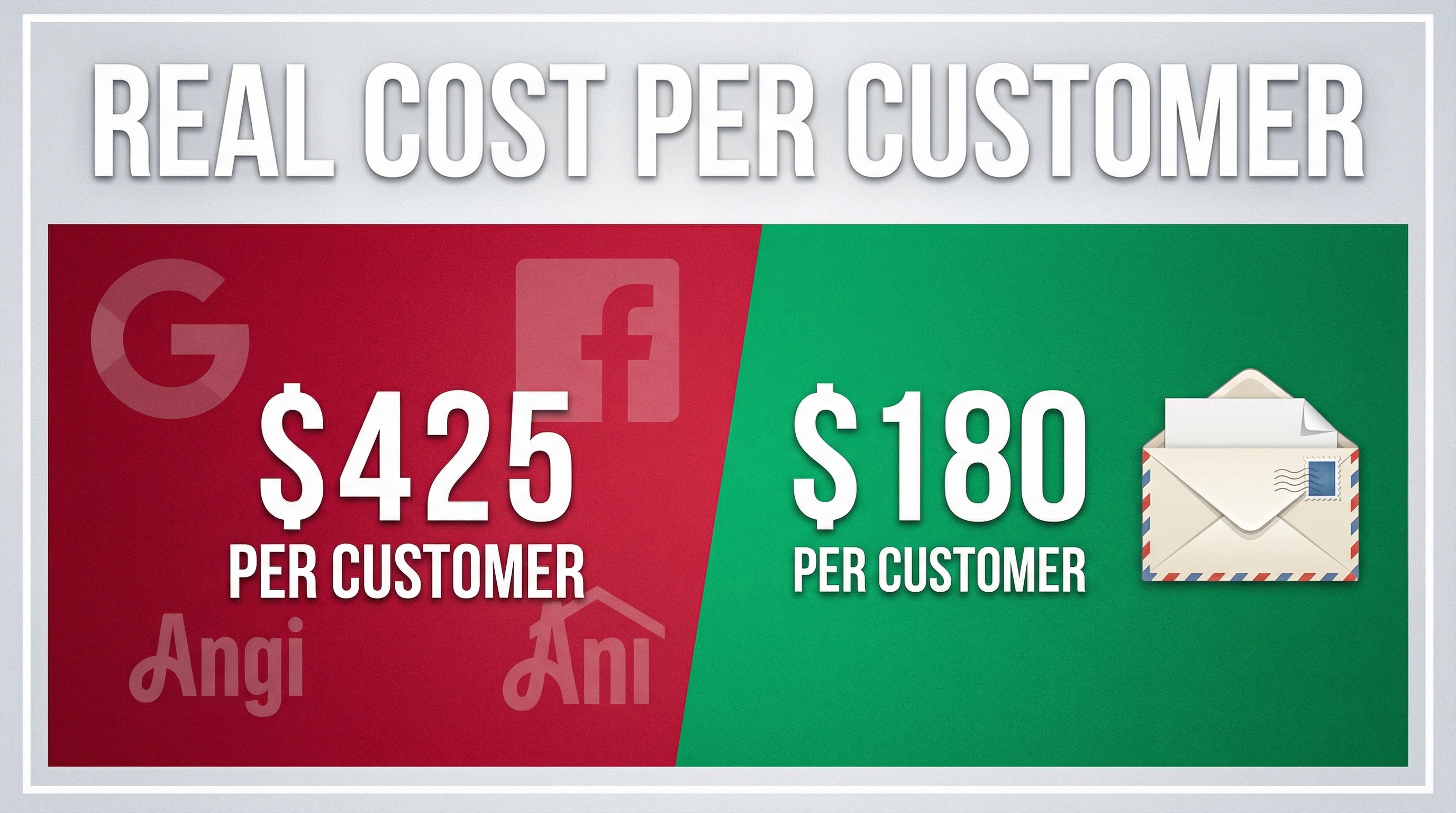
Most tree service owners can tell you their cost per lead benchmark down to the penny. Almost none of them know their actual cost to acquire a customer. That gap is where your profit disappears.
Here’s why it matters. A $25 lead from Angi that gets shared with four other companies and never closes costs you more than a $50 exclusive lead that turns into a $3,500 removal. The first one looks cheap on paper. The second one actually puts money in your account.
We’ve worked with 250+ tree service companies over the past five years, and the pattern is always the same. Owners obsess over cost per lead while ignoring the only number that actually determines whether their marketing makes or loses money: customer acquisition cost (CAC), the total cost to book one paying job.
Let’s break down the real CAC for every major channel so you can see where your money’s actually going.
CAC isn’t complicated. Take everything you spend on a marketing channel in a month. Divide it by the number of jobs you booked and got paid for from that channel. That’s your customer acquisition cost.
But most tree service owners skip the second half of that equation. They look at what each lead costs and stop there. That’s like judging a climber by how fast they get up the tree without asking if the tree actually came down.
Here’s the formula that matters:
Cost per lead / close rate = cost per booked job (CAC)
A $40 lead with a 30% close rate gives you a $133 CAC. A $40 lead with a 10% close rate gives you a $400 CAC. Same lead cost, wildly different outcomes. And that’s before you factor in drive time, wasted estimates, and platform fees that don’t show up in the “cost per lead” number.
Google Local Services Ads are the gold standard for intent. Someone searches “tree removal near me,” sees your Google Verified badge (Google rebranded from “Google Guaranteed” to “Google Verified” in October 2025), and calls. That’s a hot lead.
The problem is what’s happened to LSA over the past two years. Google’s “Get Competitive Quotes” feature now sends one homeowner’s request to multiple tree services at the same time. You’re paying for an exclusive lead that isn’t exclusive anymore.
Here’s the real math for 2026:
And that’s just the ad spend. Factor in the time you or your office manager spends managing disputes (Google’s AI auto-dispute system rejects valid claims regularly), responding within minutes to beat competitors, and driving to estimates where you’re one of three companies bidding. Your real cost climbs even higher.
Sound familiar?
LSA still works. But the days of $150 CAC from Google are fading fast in competitive markets. CPCs have risen 15-20% year over year, and the shared lead problem isn’t going away.
Angi sends the same lead to 3-5 contractors simultaneously. The homeowner knows multiple companies are competing. They’re price shopping before you even pick up the phone.
The numbers tell the story:
And those jobs you do close? They’re often the lowest-margin work you’ll do all month. Price shoppers from Angi aren’t calling because they want the best arborist in town. They want the cheapest quote. You end up doing $800 trim jobs you drove 45 minutes to estimate, competing against three other companies who all showed up the same afternoon.
There’s a reason Angi averages 1.97 out of 5 across 2,311 BBB customer reviews. Both homeowners and contractors are unhappy. If your tree service customer acquisition cost on Angi is under $300, you’re in the minority.
Thumbtack looks attractive on paper. Leads cost $15 to $40 each. That’s affordable, right?
Not when you factor in what actually happens after that lead hits your phone. Thumbtack sends each lead to 3-5 pros. The homeowner gets bombarded with calls and texts. By the time you reach them (if they answer at all), they’ve already talked to two competitors.
The hidden cost with Thumbtack is time. You’re responding to leads within seconds trying to be first, driving to scattered estimates across your entire service area, and losing bids to guys who undercut you by $200. A full day of Thumbtack estimates might net you one booked job if you’re lucky.
What’s an afternoon of your time worth when you could be running a crew?
Facebook can generate cheap leads. We won’t pretend otherwise. Well-optimized campaigns can bring cost per lead as low as $25 to $45.
The problem isn’t the lead cost. It’s the lead quality.
People scrolling Facebook aren’t looking for tree service. They see your ad, think “oh yeah, I should probably do something about that branch,” and fill out a form. Half of them don’t answer when you call back. A quarter of them want free wood or a $150 trim. The ones who are serious have already forgotten they submitted the form by the time you reach them.
Meta’s AI-optimized campaigns have made this worse since late 2024. The algorithm pushes volume over quality, and there’s no effective way to tell Meta “stop sending me people who want free firewood.” Your cost per lead looks great in the dashboard while your actual cost per paying customer bleeds you dry.
Doing your own Every Door Direct Mail is the cheapest option on a per-piece basis. You can print and mail for $0.35 to $0.55 per piece all-in. Nobody beats that price.
But here’s what that price doesn’t include: your time.
Selecting routes on the USPS website. Designing the mailer (or paying someone to). Printing. Bundling by carrier route per USPS requirements. Loading your truck. Driving to the post office. Hoping the mail actually gets delivered (EDDM is lowest-priority mail, and carriers sometimes skip routes with no accountability).
Then there’s the performance problem. Without tracking phone numbers on each route, you have zero idea which neighborhoods produced calls and which ones wasted your money. Our data across 250+ tree service campaigns shows that 75% of calls come from just 50% of the routes mailed. If you’re doing DIY EDDM, you’re paying to mail the dead routes every single month and you’ll never know it.
Factor in your time at even $50/hour, and that “cheap” DIY campaign just got a lot more expensive.
Tree Leads Today charges roughly $85 per lead on a pay-per-call model. The leads are exclusive to your zip code. And the close rates are decent because homeowners are responding to a physical mailer.
So what’s the catch? You don’t own anything.
They own the phone number on the mailer. They own the data. They own the route insights. If you leave Tree Leads Today, you walk away with nothing. Zero call history. Zero knowledge of which neighborhoods worked. You start completely over.
You’re also flying blind. You don’t know what’s being mailed, where it’s going, when it drops, or what the design looks like. Multiple tree service owners who’ve come to us from Tree Leads Today describe the same experience: decent leads, terrible transparency, and impossible-to-reach customer service. When you’re paying $85 per call, you deserve to know what you’re paying for.
This modeled range shows how response and close rate change acquisition cost even when the mailing budget stays fixed.
| Response rate on 4,600 letters | Calls | Jobs at a 35% close rate | Acquisition cost at $2,392-$3,220 mailing spend |
|---|---|---|---|
| 0.5% | 23 | 8 | $299-$403 per customer |
| 0.7% | 32 | 11 | $217-$293 per customer |
| 1.0% | 46 | 16 | $150-$201 per customer |
Here’s how our numbers break down on the Growth plan at $3,200/month for 4,600 letters across two mailings.
With a typical 0.7% response rate (which is conservative based on what we see across our client base), that’s about 32 calls per month. Tree service owners closing at 30-40% on exclusive, geographically clustered leads from direct mail book 10 to 13 jobs per month.
That’s month one. Here’s where it gets interesting.
Because every carrier route has its own tracking phone number, by month two we know exactly which routes produced calls and which ones didn’t. We cut the dead weight and scale the winners. By month three to four, clients consistently see their CAC drop to $100 to $200 per booked job as the system optimizes.
Matt Morovic with Upright Tree Care in Wisconsin 10x’d his marketing spend in his first month. He runs 5 estimates in 2 hours because they’re all in the same neighborhood. That’s what geographic clustering does to your CAC. When you’re not burning an hour driving to each estimate, every job costs less to acquire.
Alissa Tooley with A&J Specialties quoted $160,800 in 3 months and closed $69,200. She was consistently pulling $40K/month from mailer leads alone. At $3,200/month in spend, that’s roughly a 12:1 return.
Every marketing platform wants you focused on cost per lead. There’s a reason for that. Cost per lead makes their numbers look good. A $25 Thumbtack lead sounds amazing until you realize it took ten of them to book one $600 trim job.
CAC forces you to see the full picture:
A tree service running three crews can’t afford to waste afternoons driving to scattered estimates from shared lead platforms that close at 10%. That’s not a lead problem. That’s a profit problem disguised as a lead problem.
The owners we work with who grow fastest aren’t the ones with the cheapest leads. They’re the ones with the lowest CAC and the highest revenue per truck. Those two numbers together tell you everything about whether your marketing is working.
You don’t need fancy software for this. Here’s what to track every month for each channel:
Divide spend by jobs booked. That’s your CAC. Divide revenue by spend. That’s your ROI. Track both numbers monthly, by channel. Within 90 days, you’ll see exactly which channels are making you money and which ones are burning it.
If you can’t track it, you can’t improve it. And if you’re spending money on a marketing channel that doesn’t give you this data, that’s a problem worth solving.
The tree service owners who build real businesses don’t chase the cheapest cost per lead. They chase the lowest cost per paying customer. Sometimes that means spending more per lead to get exclusive, geographically clustered calls that close at 2-3x the rate of shared platform leads.
That’s the difference between marketing that looks good on a dashboard and marketing that actually fills your schedule.
One last number for context: the U.S. tree service industry is worth an estimated $26 billion a year. There’s no shortage of demand out there. The question is whether your marketing channels let you capture it profitably, or burn your margin getting it.
Want to see what your customer acquisition cost would look like with targeted direct mail in your specific zip codes? We’ll map it out for you, free.
Your move.
Ready to grow into the neighborhoods you want?
250+ tree companies use Tree Traction. See if your zip code is available.
Book a Free Strategy CallFREQUENTLY ASKED QUESTIONS
A strong tree service customer acquisition cost falls between $100 and $200 per booked job. Most companies spend $250 to $500+ without realizing it because they only track cost per lead, not cost per job that actually closes and gets paid.
Google LSA leads for tree service typically cost $30 to $85 each depending on your market. But with the 'Get Competitive Quotes' feature sending leads to multiple companies, close rates drop to 20-30%, pushing your real cost per booked job to $150 to $400+.
Cost per lead ignores close rates, drive time, and lead quality. A $30 lead you share with four competitors and never close costs you infinitely more than a $50 exclusive lead that books a $2,800 removal. Customer acquisition cost (cost per booked job) is the only metric that tells you if your marketing is actually working.
Targeted direct mail to high-tree-density neighborhoods produces some of the lowest customer acquisition costs in the industry, often $80 to $150 per booked job. The leads are exclusive, geographically clustered, and close at higher rates than shared platforms like Angi or Thumbtack.
Divide your total marketing spend (including ad fees, platform costs, and your time) by the number of jobs that actually closed and got paid. If you spent $3,200 on marketing and booked 25 jobs, your customer acquisition cost is $128 per job.
About the Author
Brayden Fielding
CEO, Tree Traction
Brayden Fielding is the founder and CEO of Tree Traction, the only direct mail company in the U.S. built exclusively for tree service businesses. He's worked with 250+ tree service companies across the country, studying what makes direct mail campaigns produce real revenue (and what makes them flop). When he's not digging into route-level data or reviewing campaign results, he's talking to tree service owners about what's actually working in their markets.
KEEP READING
Out-of-town storm chasers flood your market after every big blow. Here is how a local tree service wins those storm leads on trust, speed, and timing.
AI search is how homeowners find contractors now. What ChatGPT reads before it names a tree service, and the trust signals worth fixing this month.
A tree service keywords guide built on real 2026 cost-per-click data: what each search term is worth, what it actually books, and where it belongs.
Book a free strategy call — 30 minutes, no obligation.
Book a Free Strategy Call