
Strategy 12 min March 30, 2026 Updated August 11, 2026
Direct Mail vs Digital Marketing for Tree Service Companies

Brayden Fielding
CEO, Tree Traction
Brayden Fielding
CEO, Tree Traction
Dayde Collins with Blades Tree Removal in Provo, Utah quoted $47,000 in 30 days using direct mail. Before that, he’d tried digital marketing and agencies. His take? Tree Traction outperformed all of them.
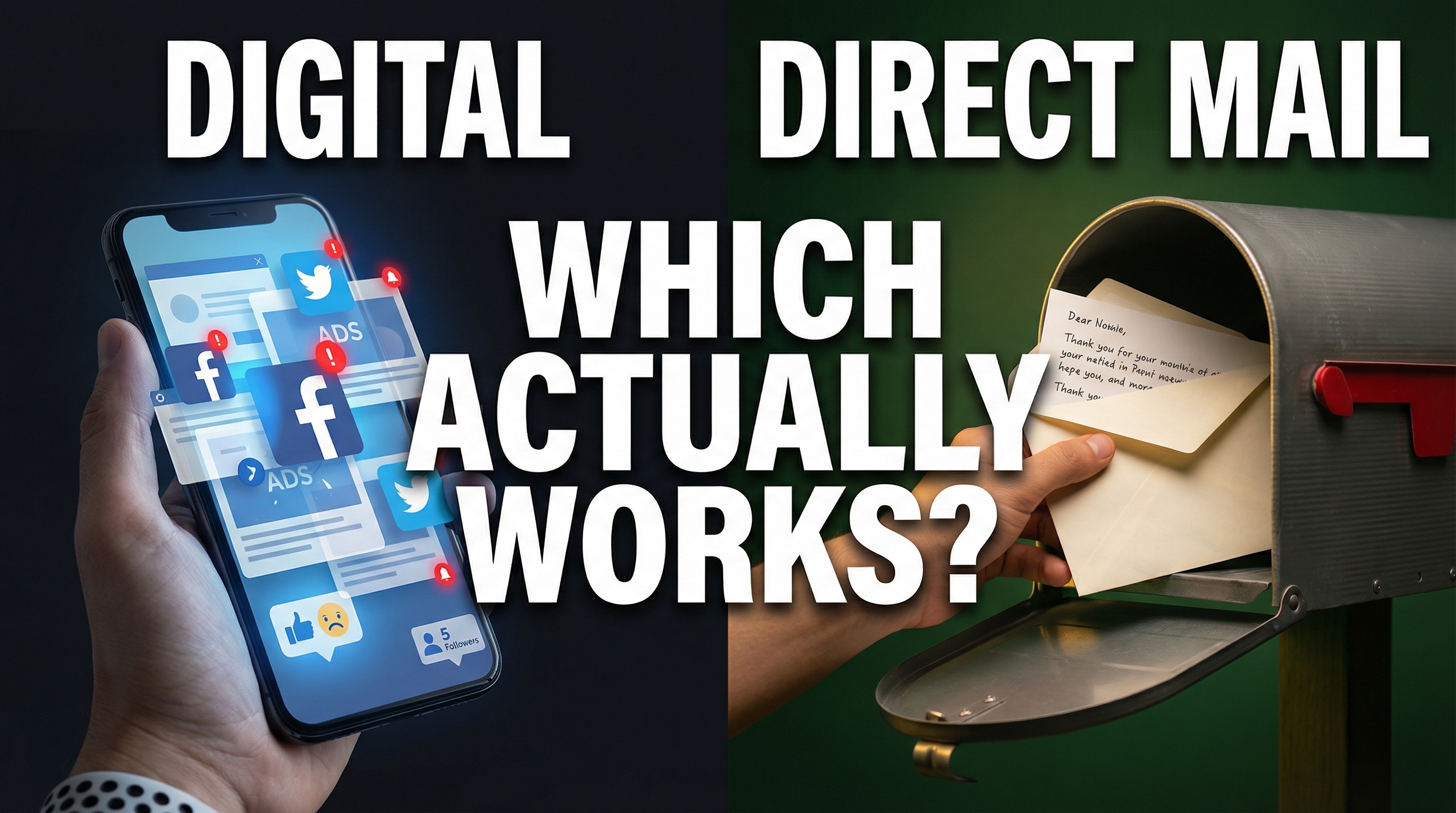
But this isn’t an article about why digital marketing is garbage. It’s about giving you an honest, side-by-side comparison so you can decide where your tree service marketing dollars actually belong.
We’ve worked with over 250 tree service companies on direct mail campaigns. We’ve seen what digital does well. We’ve seen where it falls apart. And we’ve watched plenty of owners waste thousands bouncing between Google Ads, Facebook, and Angi before landing on something that actually fills their schedule.
Let’s break it down channel by channel.
These are the operating differences to weigh alongside the 2025 ANA/DMA Response Rate Report benchmark of a 4.4% average direct mail response rate.
| Decision factor | Targeted direct mail | Google search or LSA | Facebook ads |
|---|---|---|---|
| Demand type | Creates demand in selected neighborhoods | Captures existing searches | Interrupts a social feed |
| Cost basis | $0.52-$0.70 per letter | Auction, click, or call | Auction, click, or form submission |
| Competition at contact | Homeowner calls one company | Homeowner can compare several listings | Homeowner may submit several forms |
| Geographic control | Carrier-route level | Radius, zip, or service area | Radius and audience filters |
| Optimization signal | Calls tied to individual routes | Search terms and campaign conversions | Audience and creative conversions |
Before we get into specifics, here’s the big picture. According to the 2025 ANA/DMA Response Rate Report, direct mail has a 4.4% average response rate. Email sits at 0.12%. That’s a 37x difference.
Direct mail gets opened about 90% of the time. Email? Roughly 20-30%, and that includes automated preview pane loads where nobody actually reads a word.
And here’s the stat that matters most for tree service owners: Vericast’s 2024 Direct Mail Influence Report found 58% of consumers say direct mail is trustworthy. When a homeowner gets a handwritten-style letter from a local tree company, it doesn’t feel like an ad. It feels like a neighbor reached out. When that same homeowner sees a Facebook or Nextdoor ad between cat videos and political arguments, it gets scrolled past in half a second.
Trust sells tree work. Period.
Google Ads and Local Service Ads are the go-to digital channels for tree services. And they do one thing well: they capture people who are actively searching for tree work right now.
That’s a real advantage. Someone typing “tree removal near me” has high purchase intent. No question.
But here’s the tradeoff. Google’s cost per click for tree service keywords runs $5 to $25+, and that’s before you even get a lead. You’re paying for clicks, not calls. And with LSA’s “Get Competitive Quotes” feature, Google now sends your lead to multiple tree services at once. You show up to give an estimate and find out two other companies already came by yesterday.
Sound familiar?
Direct mail flips this completely. Your letter lands in a homeowner’s hand before they ever open Google. Before they ever hit Angi. Before they ever call anyone else. You’re not competing for attention on a search results page. You’re the only tree company that homeowner has heard from. That changes the entire dynamic of the estimate. You’re not in a price war with four other companies. You’re the trusted local pro who showed up in their mailbox.
Google also quietly removed the trust marker that made LSA worth the premium. The green “Google Guaranteed” badge was retired in October 2025 and replaced with a blue “Google Verified” badge, and the $2,000 homeowner money-back guarantee went away at the same time. You’re paying more per lead for a badge homeowners no longer recognize.
The other problem with Google: platform risk. Algorithm changes, policy updates, and rising CPCs can tank your lead flow overnight. We’ve talked to dozens of tree service owners whose Google Ads went from profitable to money pit after a single update. Google’s April 2025 TOS update claimed ownership of LSA ad assets, meaning the data and performance history you build on their platform isn’t fully portable if you ever pause or leave. You don’t own anything on Google. You’re renting attention, and the landlord can raise the rent whenever they want.
Facebook is great for reach. You can put your tree service in front of thousands of homeowners for relatively little money. And retargeting (showing ads to people who already visited your website) is genuinely useful.
Those are real wins.
But the lead quality problem with Facebook is brutal for tree services. People scrolling Facebook aren’t looking for tree work. They’re looking at their grandkid’s photos and arguing about the weather. When your ad interrupts that, you get curiosity clicks. Tire kickers. People who want a “free estimate” for a $150 trim they’ll never actually book.
Multiple tree service owners have told us their Facebook lead costs tripled between 2024 and 2025 while quality dropped, and the tree service marketing trend has continued into 2026. Free-wood seekers. People wanting yard cleanups. Leads from 45 minutes outside their service area. Meta’s push toward AI-optimized Advantage+ campaigns has removed much of the targeting control tree service owners used to rely on, leaving them with broad audience delivery and no meaningful way to tell Meta which leads were actually worth anything.
Compare that to what happens with targeted direct mail. Alissa Tooley at A&J Specialties quoted $160,800 in her first 3 months and closed $69,200 from mailer leads alone. Those weren’t tire kickers. Those were homeowners with trees and money who needed real tree work done. The difference? Her mailers went to specific carrier routes selected using 295 data points including tree density, income levels, and property values. Every lead was exclusive to her.
This is the one tree service owners don’t think about until they experience it.
With Google or Facebook, you set a service area radius. Maybe 25 miles. Leads come from everywhere inside that circle. One call from the north side. Another from 40 minutes south. A third from across the county line. Your crew spends half the day driving between estimates instead of booking jobs.
Direct mail, done right, clusters your leads geographically. Matt Morovic at Upright Tree Care in Wisconsin does 5 estimates in 2 hours because they’re all in the same neighborhood. His mailers go to specific carrier routes, so calls come from concentrated areas. Less windshield time. More jobs per day. Better margins on every truck.
That geographic precision is something no digital channel can match. Google doesn’t let you target a specific carrier route. Facebook doesn’t know which streets have 80-foot oaks. But when you’re using satellite tree density data to pick routes, you’re putting mailers in the hands of homeowners who actually have trees that need work, all within a tight radius.
Here’s something most tree service owners never consider until it’s too late.
Every lead you generate through Google, Facebook, or Angi lives on their platform. If you stop paying, that data disappears. Your call history, your lead pipeline, your performance data. Gone. You start over from zero.
With platforms like Angi and Thumbtack, you don’t even own the customer relationship. They own the lead. They control who else gets it. They can change the rules tomorrow and there’s nothing you can do about it.
With a properly built direct mail system, you own everything. The tracking phone numbers. The route performance data. The knowledge of exactly which neighborhoods produce $10,000 removals and which ones produce $200 trim calls. That data compounds in value month over month. It’s an asset you’re building, not a subscription you’re renting.
Our clients own all their tracking numbers and can port them out anytime for $1.25 per number. Their dashboard shows exactly which carrier routes are producing calls and which aren’t. That information doesn’t belong to us. It belongs to them. If they ever leave, they take it all with them.
Know what happens when you leave Google Ads? You get a blank screen.
Let’s be honest about what digital does better. Because if you’re looking for a “direct mail is perfect and digital is terrible” article, you’re in the wrong place.
Speed. You can launch a Google Ads campaign today and get calls tomorrow. Direct mail takes time to design, print, and deliver. If your phone stopped ringing this morning and you need calls by Friday, digital is faster.
Past-customer email. Email marketing won’t replace direct mail for new leads, but it’s a low-cost tool for reaching past customers who already know you. A simple seasonal email to your existing database costs almost nothing and keeps repeat removals and referrals flowing. That’s a real win for digital. Just don’t expect cold email to work the same way. See how the full system fits together in our tree service email marketing guide.
Retargeting. Someone visits your website but doesn’t call. Facebook and Google can show them ads for the next 30 days. That’s a genuine advantage direct mail can’t replicate.
Scalability of budget changes. Want to spend $500 more on Google this week? Done. Want to pause for a month? Done. Direct mail campaigns require more planning and lead time.
These are real advantages. For tree service companies that already have a consistent lead source and want to layer on additional channels, digital can complement your marketing well.
But “complement” is the key word. Digital should be the side dish, not the main course. Because when you build your business on platforms you don’t control, you’re one algorithm change away from a very bad month.
And here’s the thing digital can’t replicate no matter how good your targeting is. The average piece of direct mail stays in a home for 17 days. It sits on the kitchen counter, the desk, the fridge. Multiple household members see it. The homeowner might not need tree work the day your letter arrives. But two weeks later, a storm rolls through and snaps a branch over their driveway. Guess whose letter is sitting right there on the counter?
An email has a lifespan measured in seconds. A Facebook ad disappears the moment they scroll past. A Google ad only exists while they’re searching. Direct mail creates demand. It plants a seed with homeowners who have trees and money but haven’t thought about calling a tree company yet. Digital only captures demand from people already searching.
For tree services, demand creation is where the real growth happens. You’re not fighting over the small pool of people Googling “tree removal” today. You’re building a pipeline of homeowners who call you when they’re ready.
Ricky Folse at Veteran Tree Care got 10 calls in 2 days during his slowest season on his first mail out. Those weren’t people searching Google. Those were homeowners who saw his letter and realized they’d been meaning to get that dead oak taken care of.
One thing we hear constantly from tree service owners who’ve tried digital: they can’t predict what they’ll spend or what they’ll get.
Google Ads might cost you $800 one week and $2,400 the next for the same keywords. Facebook lead costs fluctuate wildly based on competition, time of year, and algorithm changes. Pay-per-lead services like Tree Leads Today charge roughly $85 per lead, but you can’t control volume. Some weeks you get flooded. Other weeks, silence.
Direct mail pricing is flat and predictable. You know exactly what you’re spending each month. At $0.52 to $0.70 per piece, a Growth plan runs about $3,200/month for 4,600 letters across two mailings. That number doesn’t change because a competitor raised their bid or because Facebook decided to charge more this week.
Postage does move, and it moved this summer. USPS raised rates on July 12, 2026, and EDDM Retail postage went from $0.247 to $0.260 per piece, about 5%. That’s roughly $60 on a 4,600-letter month, and EDDM took a smaller increase than the 4.8% average across mail classes, so it stayed the cheapest way to put a full-size letter in a homeowner’s hand.
Compare that to what Google did to your cost per lead over the same stretch. A penny and a third per letter, announced months in advance, versus an auction that reprices itself every time another tree company in your market turns on a campaign.
For tree service owners carrying payroll, equipment payments, and overhead, predictable marketing spend isn’t a nice-to-have. It’s how you actually run a business.
If you’re running a tree service and can only pick one channel, the question comes down to what you value most.
Pick digital if you need leads by next week, you’re comfortable with shared leads and platform risk, and you don’t mind having zero control over which neighborhoods your leads come from.
Pick direct mail if you want exclusive leads, geographic clustering that cuts drive time, route-level tracking that improves results month over month, predictable costs, and full ownership of your data and phone numbers.
The best tree service companies we work with? They use direct mail as their foundation and layer digital on top. Direct mail creates the consistent, exclusive, geographically clustered leads that keep crews busy and schedules full. Digital fills in the gaps.
But the foundation matters most. Because when Google changes its algorithm or Facebook triples your cost per lead (again), your mailers are still landing on kitchen counters in neighborhoods full of mature oaks and homeowners who can afford professional tree work.
Want to see which carrier routes make sense in your area? We’ll map it out for free.
Ready to grow into the neighborhoods you want?
250+ tree companies use Tree Traction. See if your zip code is available.
Book a Free Strategy CallFREQUENTLY ASKED QUESTIONS
It depends on your goals. Direct mail wins on trust, lead exclusivity, and geographic targeting. Digital wins on speed and retargeting. For tree service companies that want consistent, exclusive leads clustered in specific neighborhoods, direct mail typically delivers higher close rates and better cost per job.
Direct mail has an average response rate of 4.4% compared to email's 0.12%, according to the 2025 ANA/DMA Response Rate Report. That makes direct mail roughly 37x more effective at generating responses. Direct mail also has a 90% open rate versus email's 20-30%.
The average direct mail piece stays in a home for 17 days. During that time, it gets seen multiple times by multiple household members. Compare that to an email, which has a lifespan measured in seconds before it's deleted or buried.
Yes, and many successful tree service companies do. Direct mail creates demand by reaching homeowners before they search online, while digital captures demand from people actively looking. The key is making sure your primary lead source gives you data ownership and exclusive leads, not shared ones.
Direct mail typically costs $0.52-$0.70 per piece with predictable monthly spend. Google Ads for tree services run $5-$25+ per click with no guarantee of a lead. When you factor in close rates and lead exclusivity, direct mail often delivers a lower cost per booked job.
About the Author
Brayden Fielding
CEO, Tree Traction
Brayden Fielding is the founder and CEO of Tree Traction, the only direct mail company in the U.S. built exclusively for tree service businesses. He's worked with 250+ tree service companies across the country, studying what makes direct mail campaigns produce real revenue (and what makes them flop). When he's not digging into route-level data or reviewing campaign results, he's talking to tree service owners about what's actually working in their markets.
KEEP READING
Direct mail response rate benchmarks for tree service companies, what the 4.4% industry average actually means, and the numbers worth planning a campaign on.
Tired of shared leads? Here are the real Angi, HomeAdvisor, and Thumbtack alternatives for tree service leads, what each one costs, and which fits your size.
Does a tree service guarantee actually close more quotes? What to guarantee, what never to guarantee, and how to write one homeowners believe.
Book a free strategy call — 30 minutes, no obligation.
Book a Free Strategy Call