
Operations 7 min April 16, 2026 Updated July 7, 2026
What to Do When the Phone Stops Ringing at Your Tree Service

Brayden Fielding
CEO, Tree Traction
Brayden Fielding
CEO, Tree Traction
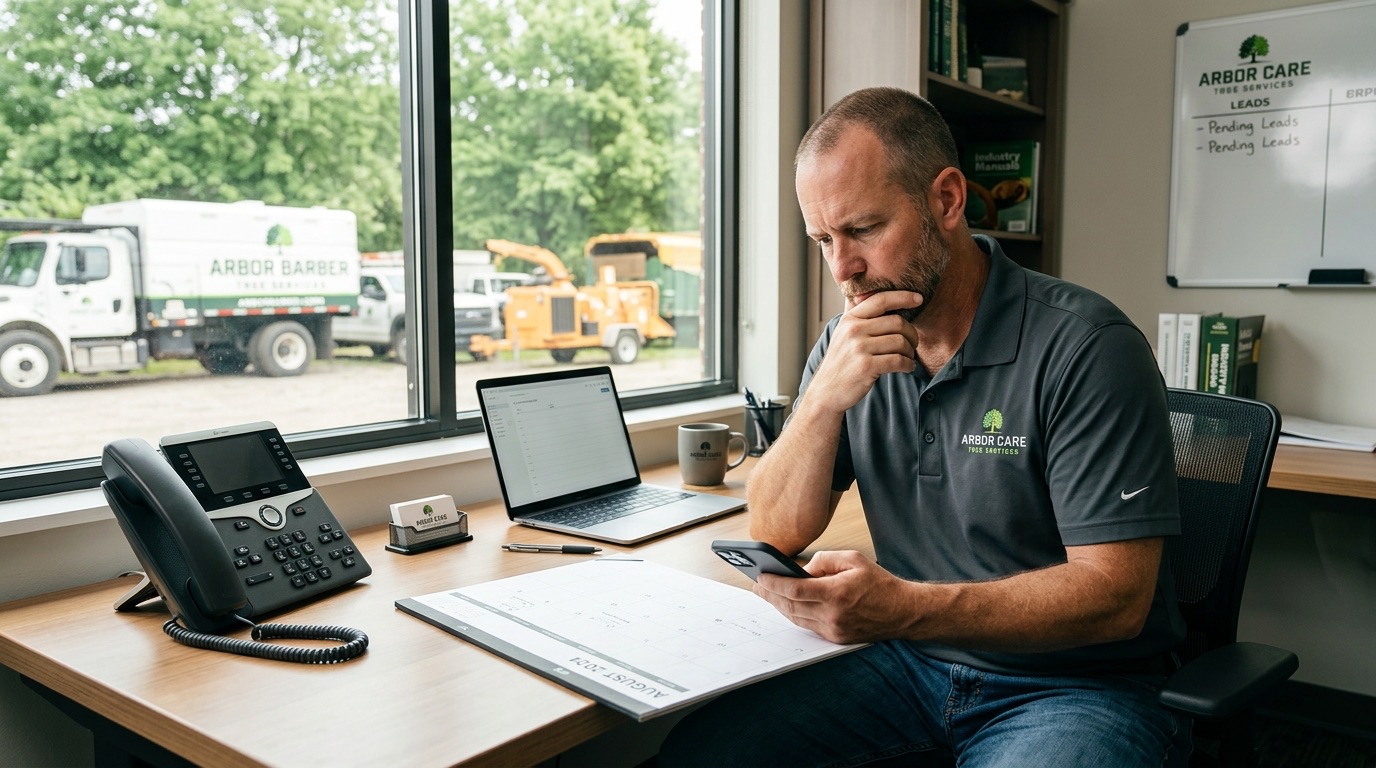
It’s Wednesday. Your last confirmed job was Friday. Your crew came in Monday and you sent them home early. The phone hasn’t rung since Tuesday of last week.
You’ve checked it. It’s working.
This is the slow-down moment. Every tree service owner knows it. The question is what you do next.
Before you can fix it, you need to know why it stopped.
There are four common causes:
1. It’s seasonal. November through February, residential tree work slows in most markets. Homeowners aren’t thinking about trees. They’re inside. This is the most common reason the phone goes quiet, and the most predictable.
2. A channel changed or failed. Google adjusted its algorithm. Your LSA account got flagged. Your Angi territory got flooded with new competitors. You lost a vendor relationship. Something that was producing leads stopped producing.
This one’s worth watching closely if Google LSA has been your main channel. Google’s “Get Competitive Quotes” feature now routes a homeowner’s request to multiple tree services at once, the same shared-call problem that used to be Angi’s alone. If your close rate on LSA calls has quietly dropped even though volume looks steady, that’s usually why, you’re now bidding against 2-3 other companies for calls you used to get alone.
3. Word-of-mouth ran its cycle. A busy spring generated a wave of referrals. That wave crested in August. Now it’s quiet because organic referrals aren’t controllable, they come in clusters and then go quiet.
4. You never had a controllable lead source. The phone was ringing because it was peak season. Now peak season ended and you realized you had no marketing engine underneath the seasonal bump. This is the most dangerous scenario because nothing changed, it’s just exposing what was always missing.
The fix depends on the cause. But there’s one thing all four causes have in common: they all get worse the longer you wait.
Most tree service owners’ response to a slow phone: wait.
They tell themselves it’ll pick up. They move slower on estimates. They stop following up with open quotes. They maybe post something on Facebook. And they wait another two weeks hoping something changes.
It doesn’t change. It gets worse.
Here’s why waiting is the most expensive mistake: your crew is still being paid, your overhead still runs, and every week of dead phone time is revenue you can never recover. If you lose a $15,000 week of production, you can’t make that up in May just by being busier. The capacity is gone.
The owners who pull out of slow periods fastest are the ones who respond immediately. They treat a slow phone the same way they’d treat a broken chip truck, something that needs to be fixed right now, not something to think about later.
When the phone stops, start with a 30-minute triage:
Check your channels one by one. What was producing leads 60 days ago? Is it still running? If you had Google LSA, pull your dashboard. How many leads did you get last month vs. two months ago? If you were using a lead service, check your account. If word-of-mouth was your primary driver, count your active referral relationships.
Identify what changed. Did a channel drop? Did a competitor move into your LSA area? Did you stop mailing? Did a key referral source go quiet? Usually something specific changed, find it.
Check the obvious stuff. Is your phone actually working? Are you showing up on Google? Has your listing expired? Are your tracking numbers forwarding correctly? Sometimes a slow phone is a technical problem, not a marketing problem.
Look at your pipeline. How many open quotes do you have? When did you last follow up on them? Quotes you sent 2-3 weeks ago and never followed up on are recoverable jobs. Call them before you do anything else.
Pipeline follow-up is the fastest path to revenue when the phone stops. Those homeowners got your quote. Life got in the way. A call this week closes some percentage of them, for free, right now.
Once you’ve done triage, the next step is adding a controllable lead source if you don’t have one.
The key word is “controllable.” Google is not controllable, you can increase spend, but you can’t control the algorithm or the competitor auction. Word-of-mouth is not controllable. Angi sends you whatever it sends you.
Direct mail is controllable. You decide how many pieces go out, to which neighborhoods, and when. More mail, more calls. It’s a dial, not a slot machine.
Ricky Folse with Veteran Tree Care got 10 calls in 2 days from his first direct mail drop, during what he called his historically slowest stretch of the year. That’s not because direct mail is magic. It’s because he put letters in the hands of homeowners in the right neighborhoods while every other tree company in his market was going quiet and waiting.
The homeowners didn’t stop having trees. They stopped being marketed to.
When your phone stops ringing, homeowners with trees and money still exist. They’re just not hearing from you. Getting mail into those neighborhoods is the fastest way to change that.
The catch: direct mail takes 10-14 days to hit mailboxes after you commit. It’s not same-week volume. Which is why the time to start is before the phone stops, not after. But if you’re already in a slow period, starting now is still better than starting in three weeks.
The feast-or-famine cycle feels like weather, like something that just happens to tree service companies every year. It’s not. It’s the result of a single uncontrollable lead source that peaks and troughs with the season.
Companies that eliminate feast-or-famine don’t do it by being better at tree work. They do it by having a marketing channel that doesn’t depend on the season. Direct mail works in January because you’re choosing which neighborhoods to target, you pick the ones with dormant pruning jobs, lot clearing, storm debris from December, or homeowners who finally have time to deal with that dead oak they’ve been ignoring.
The slow season marketing playbook covers exactly how to do this, what to mail, what messaging works in winter, and how to build a backlog that carries you into spring instead of scrambling for it.
And the spring marketing playbook covers the flip side: how to front-load your spring calendar so you’re not scrambling when peak season arrives. The tree service companies that own spring start mailing in February, they’re collecting route data and booking jobs while everyone else is still waiting for the phone to ring.
Here’s the difference between a tree service with a controllable lead source and one without:
Without: November hits. Phone slows. Owner waits. January is brutal. February cash flow crisis. Rush-hire in April when work finally comes back. Behind all season trying to recover lost margin.
With: November hits. Mail volume stays steady. 18-22 leads still come in from the targeted neighborhoods. Owner books the lighter winter jobs, keeps one crew busy, maintains cash flow. February, he bumps mail volume to front-load spring. By April he already has a backlog.
The difference isn’t that one owner got lucky and the other didn’t. It’s that one of them built a lead engine they control and the other is still depending on what comes to him.
If your phone just stopped ringing, do the triage now. Follow up your open pipeline today. And if you don’t have a controllable lead source, that’s the problem worth solving before next slow season hits.
Want to see what lead volume from direct mail would look like in your market? Schedule a call and we’ll map out which neighborhoods make sense before you commit to anything.
Ready to grow into the neighborhoods you want?
250+ tree companies use Tree Traction. See if your zip code is available.
Book a Free Strategy CallFREQUENTLY ASKED QUESTIONS
The most common reasons: seasonal slowdown (November-February), a marketing channel you depend on changed or failed, word-of-mouth dried up, or you never had a controllable lead source to begin with. The fix depends on the cause, but the fastest recovery path is adding a channel where you control the volume, one that doesn't depend on the season or someone else's algorithm.
Don't wait. The owners who recover fastest are the ones who respond immediately, they add a direct mail blast, turn up their Google LSA budget, or call their best past customers for referrals. Every week you wait is a week of crew capacity you can't get back. Triage your channels, identify what dropped, and add a controllable source fast.
Most tree service companies start getting calls within 10-14 days of their first mail drop. The volume builds over 2-3 months as route-level data accumulates and underperforming routes get cut in favor of winners. It's not instant, which is why waiting until the phone stops ringing to start is the wrong time, it should already be running.
Feast or famine cycles almost always trace back to a single uncontrollable lead source. When you depend on Google for most leads, an algorithm change tanks your volume. When you depend on word-of-mouth, referrals cluster and then go quiet. The fix is a primary channel you control, where you choose how many leads you get instead of waiting for them to arrive.
No. That's the worst time to cut marketing. When the phone stops ringing, you need to add lead volume, not subtract it. Cutting marketing during a slow period is how a 3-week dry spell turns into a 3-month crisis. The companies that pull out of slow seasons fastest are the ones who stayed in the market (or doubled down) while others went quiet.
About the Author
Brayden Fielding
CEO, Tree Traction
Brayden Fielding is the founder and CEO of Tree Traction, the only direct mail company in the U.S. built exclusively for tree service businesses. He's worked with 250+ tree service companies across the country, studying what makes direct mail campaigns produce real revenue (and what makes them flop). When he's not digging into route-level data or reviewing campaign results, he's talking to tree service owners about what's actually working in their markets.
KEEP READING
Tree service subcontracting looks like free money until you run the margin. What subbing a job out really pays, when to rent instead, and when to say no.
When to buy a second truck for your tree service, what a second crew costs monthly, and how route-level call data proves demand is real before you sign.
Tree service answering service vs an in-house CSR: real 2026 costs, booking rates, and the call volume threshold that tells you which one you should run.
Book a free strategy call — 30 minutes, no obligation.
Book a Free Strategy Call