
Strategy 10 min March 30, 2026 Updated August 10, 2026
Tree Service Direct Mail ROI: What to Expect in Your First 90 Days

Brayden Fielding
CEO, Tree Traction
Brayden Fielding
CEO, Tree Traction
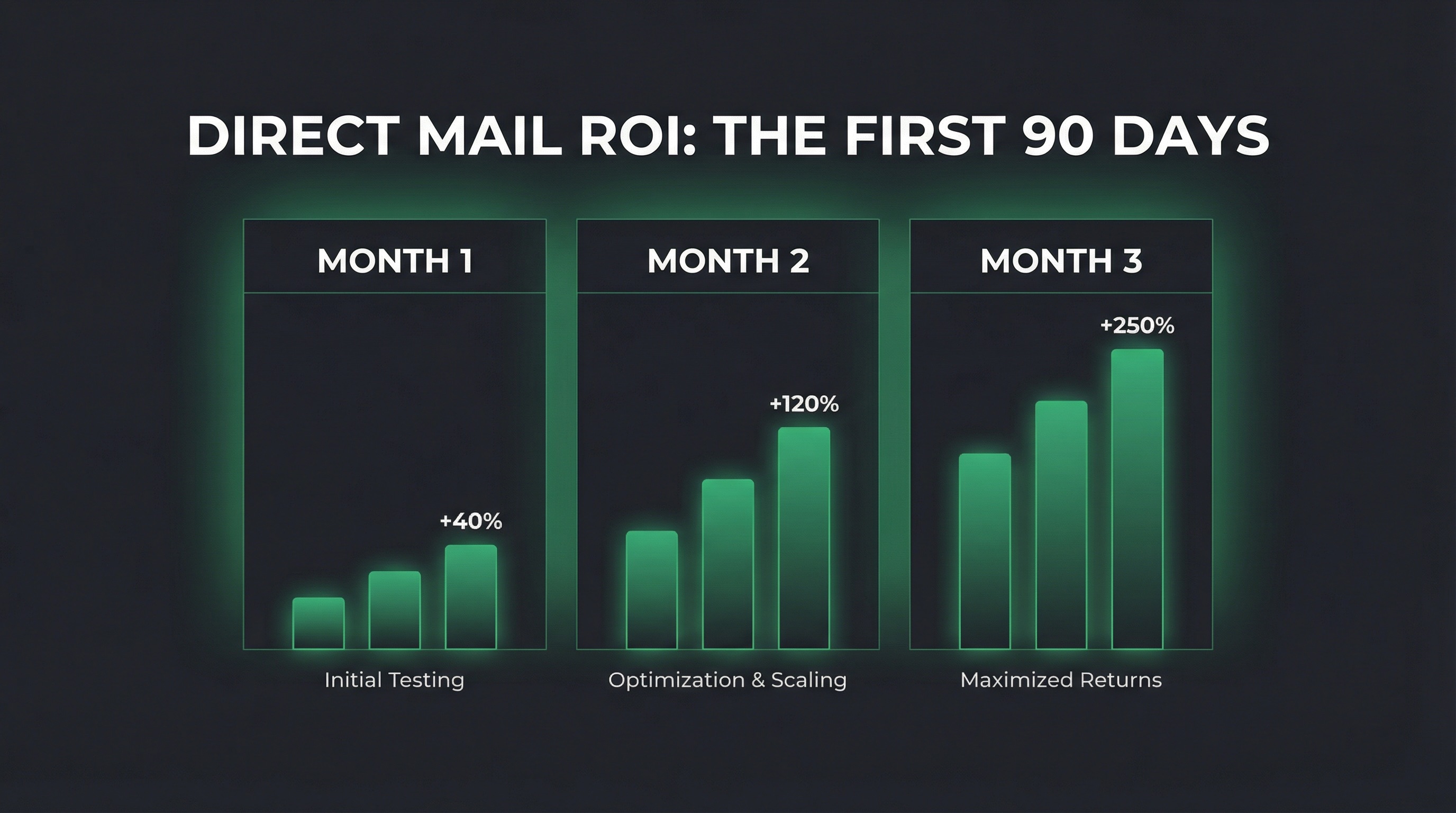
Targeted tree service direct mail can produce a positive return in the first 90 days, but month three is the fair decision point because route data needs time to identify winners. At $0.52-$0.70 per letter, the return depends on call volume, close rate, and collected revenue, not a promised result.
Carlos Morales with JC Tree Care quoted $40,600 in his first week of direct mail. That’s not typical for week one. But it’s real, and it tells you something important about what’s possible when the right mailer hits the right mailboxes.
Here’s what most tree service owners want to know about direct mail ROI before they spend a dime: what does the first 90 days actually look like? Not the highlight reel. Not the best-case scenario.
The real, month-by-month trajectory that 250+ tree service companies have experienced.
Let’s break it down.
If someone tells you direct mail will crush it from day one, they’re lying to you. Or they don’t understand how direct mail actually works.
Month 1 is your baseline. It’s the starting line, not the finish. Your first mailing is going out to carrier routes selected using 295 data points (tree density, homeowner income, property values, canopy health), but there’s one thing data can’t predict perfectly: which specific routes will respond best in your market.
That’s not a flaw. That’s the entire reason route-level tracking exists.
Think about it this way. A tree service running Google Ads doesn’t expect their first month’s cost-per-lead to be their permanent cost-per-lead. They test keywords, cut what doesn’t convert, and double down on what does.
Direct mail works the same way, but only if you’re tracking at the route level with unique phone numbers per carrier route. Without that, you’re flying blind.
Your first blast hits mailboxes. Here’s what happens.
Calls start coming in within 2-3 weeks of the first mailing. These are homeowners who pulled your letter off the kitchen counter, looked at the trees in their yard, and picked up the phone.
They weren’t searching Google. They weren’t on Angi requesting quotes from five companies. They called you because your mailer was in their hand.
Some months, that first blast lights up the phone. Carlos Morales quoted $40,600 in his first week. Ricky Folse with Veteran Tree Care got 10 calls in 2 days during his slowest season on his very first mail out.
But those are the high end.
A more common month 1 looks like this: you send 2,300 letters to a carrier route area, get a handful of calls, quote a few jobs, and close some of them. Your total revenue from mailer leads might cover your spend or slightly exceed it. Not life-changing yet.
But here’s what you have that you didn’t have before: data.
Every single carrier route has its own tracking phone number. So you know exactly which neighborhoods produced calls and which ones didn’t. That information is worth more than the calls themselves, because it’s what makes month 2 dramatically better.
This is where direct mail ROI starts separating from every other marketing channel.
Our internal data across 250+ tree service campaigns shows that roughly 75% of all calls come from just 50% of routes mailed. Read that again.
Half your routes are producing almost nothing. The other half is doing the heavy lifting.
If you’re doing DIY EDDM or using a provider with no route-level tracking, you’d never know this. You’d keep mailing every route at the same volume, wasting half your budget every single month. Sound familiar?
Month 2 is when your account manager sits down with the tracking data, identifies which routes are generating calls, and makes the cut. Underperforming routes get dropped. High-performing routes get increased frequency or expanded into adjacent carrier routes with similar demographics.
This is the optimization loop that makes direct mail compound over time. It’s the same concept behind geographic clustering, where you concentrate your mailings so incoming calls are in the same neighborhoods, cutting drive time between estimates.
Your cost per lead drops. Your call volume goes up. And you didn’t change a single thing about your operation.
By month 3, you’re running an optimized campaign. Dead routes are gone. Winning routes are getting hit again. Our internal data across 250+ tree service campaigns shows that 75% of calls come from just 50% of routes mailed, so cutting underperformers puts more of your spend into the neighborhoods that produce.
Your mailer design has been refined based on what’s actually working in your specific market.
This is where clients start seeing real tree service direct mail ROI.
Alissa Tooley with A&J Specialties quoted $160,800 in her first 3 months. She closed $69,200 of it. Her campaign didn’t start at that pace.
It built to it. In her first 2 weeks, she had $25K serviced and paid. By month 3, she was consistently pulling $40K/month from mailer leads alone.
Lars Kangas with Kangas Tree Service quoted $76K and closed $61K in his first 6 weeks. His words: “The leads are very, very serious leads and 99% of them want tree work.” That close rate didn’t happen by accident. It happened because targeted direct mail reaches homeowners with money and trees, not price shoppers clicking “get competitive quotes” on Google.
The pattern is consistent. Month 1 sets the baseline. Month 2 optimizes.
Month 3 compounds.
Here is a sensitivity check for the same $3,200 campaign using a 35% close rate and a $1,800 average job value.
| Response rate on 4,600 letters | Calls | Booked jobs | Closed revenue | Revenue-to-spend ratio |
|---|---|---|---|---|
| 0.5% | 23 | 8 | $14,400 | 4.5x |
| 0.7% | 32 | 11 | $19,800 | 6.2x |
| 1.0% | 46 | 16 | $28,800 | 9.0x |
This is a sensitivity model, not a promised result. Route decisions draw on aggregate experience from 250+ tree service companies, 10,000,000+ letters, and 150,000+ calls.
Let’s run the numbers on a typical Growth plan so you can see what this looks like in dollars.
Monthly spend: ~$3,200 for 4,600 letters across 2 mailings
Month 1 (conservative): 15-20 calls, 8-10 estimates, 4-5 closed jobs. If your average job is $1,500, that’s $6,000-$7,500 in revenue. Roughly 2x your spend.
Month 2 (after route optimization): 20-30 calls from fewer, better routes. More estimates in tighter geographic areas (less windshield time). 6-8 closed jobs. Revenue: $9,000-$12,000. That’s 3-4x your spend.
Month 3 (compounding): 25-35+ calls from proven routes getting repeat mailings. Higher close rates because homeowners have now seen your name multiple times. 8-12 closed jobs. Revenue: $12,000-$18,000. That’s 4-6x your spend.
And those are conservative numbers based on a $1,500 average job. If you’re doing removals averaging $3,000-$5,000, the math gets ridiculous fast. Matt Morovic with Upright Tree Care 10x’d his marketing spend in his first month and does 5 estimates in 2 hours because they’re all in the same neighborhood.
We hear this on almost every sales call. It’s the #3 objection we get from tree service owners considering direct mail.
Here’s what actually happened in most of those cases.
They sent a batch of postcards or generic flyers with a single phone number, no route-level tracking, no A/B testing, and no optimization plan. (This is why cheap providers like Leaf Leads produce flat results.) They mailed once or twice, got a few calls (or none), and concluded direct mail doesn’t work.
That’s not a direct mail failure. That’s a tracking failure.
Without unique phone numbers per carrier route, you can’t diagnose anything. Was it the design? The neighborhoods? The timing? The messaging?
You have zero idea. So you either keep doing the same thing and wasting money, or you quit and assume the channel is dead.
The difference with route-level tracking is that every single variable becomes measurable. We’ve worked with 250+ tree service companies, and the ones who “failed” at direct mail before almost always had the same problem: no feedback loop. They were doing spray and pray instead of test, track, and scale.
Does direct mail work for every tree service company? No channel works for everyone. But when you can actually see which routes produce calls and which ones don’t, the question changes from “does direct mail work?” to “which neighborhoods work best for my business?”
Not every tree service direct mail campaign produces the same ROI. After watching 250+ companies run campaigns, here’s what separates the ones who get average results from the ones who get exceptional results.
They don’t quit after month 1. The compounding effect is real, but it requires at least 90 days to kick in. Tree service owners who bail after one mailing never see the optimization phase. They walk away right before the good part.
They answer the phone. This sounds obvious. It’s not. Missed calls from mailer leads don’t call back the same way a Google lead might.
That homeowner saw your letter, called on impulse, and if nobody picks up, they move on. A dedicated person answering calls (or a quality answering service) changes everything. The tree service industry now employs around 175,000 businesses competing for the same homeowners, so when your letter generates a call, speed of answer is what separates a booked job from a wasted mailer.
They close at a reasonable rate. Direct mail leads are warmer than Google LSA leads because the homeowner isn’t comparing five quotes simultaneously. But you still have to show up, give a fair price, and be professional. The leads are yours exclusively, and what you do with them is on you.
They trust the data over their gut. Sometimes the route you “know” should work doesn’t. Sometimes the zip code you’ve never worked in produces your best calls. The companies that let the tracking data drive their route decisions outperform the ones who override the data based on instinct.
Here’s your realistic expectation framework, based on what we’ve seen across 250+ tree service campaigns.
Weeks 1-2: Campaign setup. Route selection based on 295 data points per carrier route (including satellite tree density analysis that no other company in the country has). Mailer design, custom for your business. Tracking numbers assigned to each route.
Weeks 3-4: First blast hits mailboxes. Calls start coming in. You’re quoting jobs and building your baseline data.
Weeks 5-8: Second and third blasts. Tracking data starts revealing which routes are producing. Your account manager begins the optimization process. Some routes get cut. Winners get reinforced.
Weeks 9-12: Optimized campaign is running. Underperforming routes are gone. You’re mailing proven neighborhoods with refined messaging. Call volume is up. Cost per lead is down. Revenue per mailing dollar is climbing.
By the end of 90 days, you have something no other marketing channel gives you: a direct mail system that gets better every month, built on data you own.
Those tracking numbers? Yours. The route performance data? Yours. The knowledge of exactly which neighborhoods produce paying tree service customers? That’s yours to keep even if you leave.
That’s the difference between renting leads from a platform like Angi and building a marketing asset that compounds in value over time.
Your first month won’t be your best. We’re honest about that. But it will be the foundation for every month that follows.
We’ll map out the highest-potential carrier routes in your service area, show you exactly where the trees and the money are, and build a 90-day plan based on what’s actually worked for 250+ tree service companies across the country.
Schedule a free route analysis and we’ll show you which neighborhoods make sense for your business. No contracts. No pressure. Just data.
Ready to grow into the neighborhoods you want?
250+ tree companies use Tree Traction. See if your zip code is available.
Book a Free Strategy CallFREQUENTLY ASKED QUESTIONS
Most tree service companies see their first calls within 2-3 weeks of the first mailing hitting mailboxes. Month 1 is your baseline, not your best month. By month 3, campaigns typically produce significantly better results because underperforming routes have been cut and winners scaled.
Tree service companies using route-level tracked direct mail typically see 3-5x ROI by month 3, with some clients exceeding 10x. For example, one client quoted $76K and closed $61K in his first 6 weeks on a campaign costing roughly $3,200/month.
Most failed direct mail campaigns share the same problem: no tracking. Without unique phone numbers per carrier route, you can't tell which neighborhoods produced calls and which didn't. You end up mailing the same underperforming routes month after month with no way to improve.
A typical growth plan runs about $3,200/month for approximately 4,600 letters across two mailings. Per-piece pricing ranges from $0.52 to $0.70 depending on volume. That covers design, printing, postage, route-level tracking with unique phone numbers, and ongoing optimization.
They serve different purposes. Google captures people already searching for tree service. Direct mail creates demand by reaching homeowners who need tree work but haven't searched yet. Direct mail also avoids the bidding wars and shared leads that plague Google LSA, and results improve over time rather than getting more expensive.
About the Author
Brayden Fielding
CEO, Tree Traction
Brayden Fielding is the founder and CEO of Tree Traction, the only direct mail company in the U.S. built exclusively for tree service businesses. He's worked with 250+ tree service companies across the country, studying what makes direct mail campaigns produce real revenue (and what makes them flop). When he's not digging into route-level data or reviewing campaign results, he's talking to tree service owners about what's actually working in their markets.
KEEP READING
Out-of-town storm chasers flood your market after every big blow. Here is how a local tree service wins those storm leads on trust, speed, and timing.
AI search is how homeowners find contractors now. What ChatGPT reads before it names a tree service, and the trust signals worth fixing this month.
A tree service keywords guide built on real 2026 cost-per-click data: what each search term is worth, what it actually books, and where it belongs.
Book a free strategy call — 30 minutes, no obligation.
Book a Free Strategy Call