
Growth 9 min April 10, 2026 Updated July 1, 2026
How to Fill Your Tree Service Schedule During the Slow Season

Brayden Fielding
CEO, Tree Traction
Brayden Fielding
CEO, Tree Traction
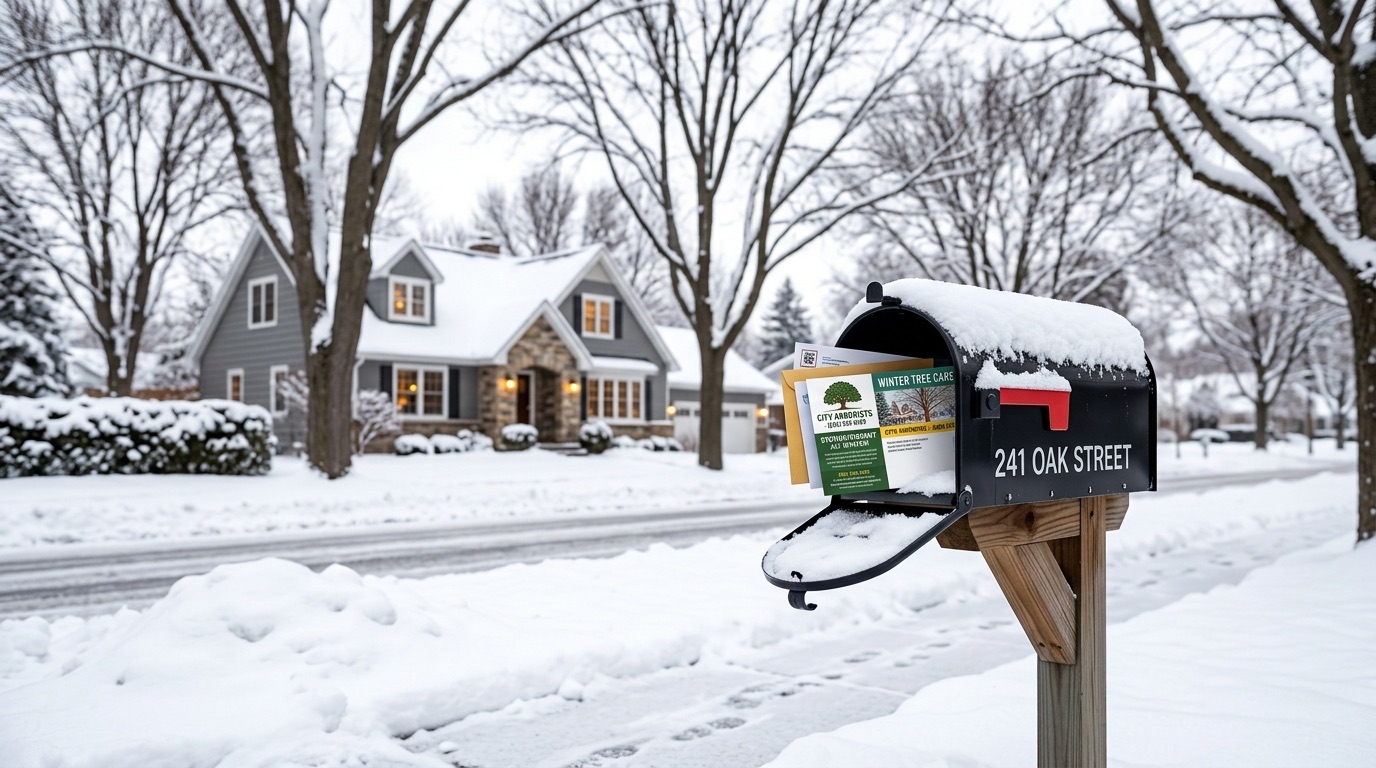
Ricky Folse with Veteran Tree Care got 10 calls in 2 days during the slowest season of the year. His first mail drop. Not his fifth. Not after months of tweaking. The very first one.
Meanwhile, most tree service owners are sitting in the shop in January watching their phone collect dust, wondering if they should lay off a crew member to make payroll.
The difference isn’t the market. It’s the strategy.
Here’s what actually happens between November and February. Homeowners still have trees. Those trees still have dead branches, cracked limbs, and root issues that aren’t going away because it’s cold outside.
The demand doesn’t disappear. It goes dormant, just like the trees.
The real problem? Nobody’s reminding homeowners that winter is the best time to get tree work done.
When your marketing stops, your phone stops. And when your phone stops, you start making desperate decisions. Cutting crew hours, taking jobs you’d normally pass on, driving 45 minutes for a $300 trim because it’s the only call you got this week.
Sound familiar?
The tree service companies that stay booked through winter aren’t lucky. They’re the ones who figured out that consistent lead generation doesn’t take a season off.
Most tree service companies slash their marketing budget the second October hits. Your competitors stop running ads, pull back on Google spend, and stop mailing altogether.
That’s your window.
When 8 tree companies are competing for the same homeowner’s attention in June, you’re in a dogfight. But in January? Maybe 2 or 3 are still visible.
Your cost per lead drops. Your close rate goes up. And you’re building a backlog of work while everyone else is sitting around waiting for spring.
Think about it this way. A homeowner who calls you in January isn’t price shopping on Angi against four other companies. They’re calling because they have a problem and you’re the only tree service they’ve heard from.
That’s a completely different sales conversation than the one you have in July when they’ve already gotten three quotes.
Ricky’s 10 calls in 2 days during the off-season weren’t an accident. He was the only tree service company putting his name in front of those homeowners.
No competition in the mailbox. No bidding war. Just his letter, on their kitchen counter, when they noticed that dead oak out the window.
Here’s where most tree service marketing falls flat during the slow season. They try to sell the same services with the same messaging they use in peak season. “Call us for a free estimate!” doesn’t work in December because homeowners aren’t thinking about tree work.
You have to create the demand. And you do that by telling homeowners what they don’t know.
Dormant pruning is easier on trees, cheaper for the homeowner (no foliage to deal with), and produces better results. Without leaves, your crew can see the full structure and identify weak points that are invisible in summer. That’s a compelling reason to call now instead of waiting until April.
Hazard tree assessment is critical before ice season. Just half an inch of ice accumulation can add 500 pounds to a tree’s canopy. A dead limb that’s been hanging for six months becomes a real liability the moment the first ice storm hits.
Homeowners don’t think about this until a branch is through their roof.
Lot clearing and stump grinding are perfect winter jobs. The ground is often firmer (easier equipment access in many regions), there’s no landscaping to damage, and homeowners planning spring construction projects need the work done before the ground thaws.
Storm damage prevention is a message that writes itself. “We’d rather trim that limb for $400 now than remove it from your roof for $4,000 in February.” Every homeowner with a mature tree near their house understands that math.
The key is shifting your messaging from “we do tree work” to “here’s why smart homeowners get tree work done in winter.” That’s creating demand, not just trying to capture it.
Google search volume for tree service keywords drops 35-40% during winter, and the cost per click doesn’t drop with it. Home services CPCs pushed past $8 average in 2026, up double digits year over year. That means Google LSA and paid search get more expensive right when fewer people are searching.
Facebook’s lead quality is already questionable for tree services, and it gets worse during months when nobody’s thinking about their yard.
Direct mail doesn’t have this problem. Your letter lands in a homeowner’s mailbox whether they were thinking about tree work or not. It sits on their kitchen counter for an average of 17 days.
And when they walk by the window and notice that dead branch for the hundredth time, your number is right there.
That’s the fundamental difference between capturing demand and creating it. Digital marketing only works when someone’s already searching. Direct mail puts your name in front of homeowners before they ever open Google.
Matt Morovic with Upright Tree Care 10x’d his marketing spend his first month. One of the reasons his results were that strong? His estimates were geographically clustered.
Instead of driving 45 minutes between bids, he was doing 5 estimates in 2 hours in the same neighborhood. That’s more revenue with less windshield time, which matters even more during the slow season when every dollar counts.
Let’s run the numbers. A Growth plan with Tree Traction runs about $3,200/month for 4,600 handwritten-style letters across two mailings. Even during winter, well-targeted campaigns pull a 0.5-0.7% response rate.
That’s 23-32 inbound calls per month from homeowners in neighborhoods with high tree density and incomes that support professional tree work. Not shared leads. Not tire kickers from Facebook wanting free firewood.
Homeowners who picked up your letter and called you.
Now here’s the part most companies miss. Your customer acquisition cost during winter is actually lower than during peak season because you’re not competing against a flood of other marketing.
Close rates on winter direct mail leads run higher because the homeowner isn’t comparing four quotes simultaneously. They called you. Period.
At 95% booking rate and a 35-65% estimate close rate, with an average job value of $1,500-$2,000 (winter jobs tend to be larger since they’re often removals and major pruning), you’re looking at $15,000-$46,000 in revenue from a $3,200 investment. That’s not theory. That’s math based on data from 250+ tree service campaigns.
And every month you mail, your results get better. With route-level tracking, you know exactly which neighborhoods are producing calls and which ones aren’t.
Cut the dead routes. Double down on the winners. By the time spring hits, your campaign is already optimized while your competitors are starting from zero.
Here’s what happens when you keep mailing through the slow season while everyone else goes dark.
By November, you’ve been mailing the same neighborhoods for months. Homeowners have seen your name two, three, four times. That recognition compounds.
When spring hits and they’re suddenly motivated to get tree work done, who do they call? The company whose letter they’ve been seeing all winter, or the one that just showed up for the first time in March?
Abraham Adams with Westwood Tree Service increased his income by $10-15K per month using direct mail. That kind of growth doesn’t happen by mailing only during peak season. It happens through consistency, through being the name homeowners see month after month regardless of the calendar.
The companies that mail through winter also have a massive data advantage heading into spring. They’ve got months of route-level performance data showing which neighborhoods respond, which messaging works, and which routes to cut.
When spring demand spikes, their campaign is already dialed in.
The companies that stopped mailing in October? They’re starting from scratch. No data, no brand recognition, no momentum. They’re three months behind before they send their first letter.
The slow season isn’t something that happens to you. It’s a competitive advantage if you use it right.
While your competitors are cutting costs, laying off crew, and hoping for an early spring, you can be building a pipeline that carries you straight through February and into the busiest months of the year. The tree service companies that hit $1M+ aren’t the ones with the best climbers or the newest equipment. They’re the ones that figured out how to grow consistently by never turning off their marketing.
Ricky got 10 calls in 2 days during the slowest time of the year. Alissa was pulling $40K a month from mailer leads. Carlos quoted $40,600 in his first week.
None of them waited for perfect conditions.
Your move.
Want to see which neighborhoods would produce calls in your service area this winter? We’ll map it out for free.
Ready to grow into the neighborhoods you want?
250+ tree companies use Tree Traction. See if your zip code is available.
Book a Free Strategy CallFREQUENTLY ASKED QUESTIONS
The slow season for most tree service companies runs from November through February. Work drops significantly as homeowners stop thinking about their trees during colder months. January and February are typically the slowest, with some companies seeing a 40-60% revenue drop from peak summer months.
The most effective winter lead strategy is direct mail targeting homeowners who need dormant pruning, hazard tree removal, and storm prep. Unlike Google or Facebook, direct mail creates demand by reminding homeowners their trees need attention before spring. Route-level tracking lets you see exactly which neighborhoods respond.
Yes. Most tree service companies cut marketing during winter, which means less competition for leads. Companies that maintain consistent marketing through the slow season build a backlog heading into spring and avoid the feast-or-famine cycle that kills growth.
Focus on dormant pruning, hazard tree assessment, storm damage prevention, lot clearing, and stump grinding. Winter is actually the ideal time for major pruning because trees are dormant, which means less stress on the tree and easier access for your crew without foliage in the way.
Don't cut your marketing budget during winter. A consistent direct mail campaign at $3,200/month for 4,600 targeted letters keeps your pipeline full and generates data that improves results heading into peak season. The companies that scale back in November are the same ones scrambling for work in January.
About the Author
Brayden Fielding
CEO, Tree Traction
Brayden Fielding is the founder and CEO of Tree Traction, the only direct mail company in the U.S. built exclusively for tree service businesses. He's worked with 250+ tree service companies across the country, studying what makes direct mail campaigns produce real revenue (and what makes them flop). When he's not digging into route-level data or reviewing campaign results, he's talking to tree service owners about what's actually working in their markets.
KEEP READING
Tree service businesses sell for 2x to 4x SDE. Here's what sets the multiple, what buyers discount hardest, and why owning your call data raises the number.
Crane tree removal jobs pay several times a standard takedown. Here's how to find the neighborhoods holding those trees and get the phone to ring.
What tree service online reputation management actually covers, what the agencies charge for it, and which parts you can run yourself in a few minutes a week.
Book a free strategy call — 30 minutes, no obligation.
Book a Free Strategy Call