
Strategy 9 min March 30, 2026 Updated August 10, 2026
Tree Service Direct Mail vs Facebook Ads: Why Your Leads Are Garbage

Brayden Fielding
CEO, Tree Traction
Brayden Fielding
CEO, Tree Traction
Dayde Collins with Blades Tree Removal in Provo spent years running Facebook ads before switching to direct mail. He quoted $47,000 in his first 30 days with mailers and closed $25,000 of it. His take: Tree Traction outperformed every digital marketing channel and agency he’d tried.
That story isn’t unusual. We hear it on almost every sales call at this point.
Here’s what happened to tree service Facebook ads over the last two years. Costs jumped. Lead quality cratered. And the platform’s own AI made things worse.
Facebook’s average cost per lead for home services hit $34 in 2026, up 11% from the year before. For landscaping and tree service specifically, benchmarks track even higher at $58 or more per lead. But the real damage isn’t the cost per lead. It’s what you get for that money.
When someone sees your Facebook ad, they weren’t looking for tree service. They were scrolling through vacation photos and funny videos. Your ad interrupted them. Maybe they tap the form, maybe Facebook auto-fills their info, and now you’ve got a “lead” who barely remembers submitting it.
That’s not a tree service lead. That’s a name on a list.
Meta’s ad algorithm is designed to do one thing: get form fills. It finds the people most likely to submit a lead form and shows them your ad. Sounds great in theory.
In practice, the people most likely to fill out forms are the people who fill out every form. Tire kickers. Coupon hunters. People who want a free estimate they’ll never follow through on. The algorithm doesn’t know the difference between a homeowner sitting on a $12,000 removal job and someone who wants free firewood from your next takedown.
And here’s the part that really stings. You can’t send quality feedback back to Meta’s system in any meaningful way. Google LSA at least lets you dispute bad leads. With Facebook, the algorithm keeps optimizing for volume regardless of whether those leads ever turn into booked jobs. You’re training the machine to find you more garbage.
Home services lead conversion rates on Facebook have dropped year-over-year for two years running. Meta’s Advantage+ AI campaigns, which stripped most targeting control from advertisers in 2025, continued expanding in 2026, giving the algorithm even more say over who sees your ad regardless of the homeowner profiles you actually want to reach. You’re training the machine to find you more garbage, and you can’t stop it.
Talk to any tree service owner who’s run Facebook ads for more than a few months and you’ll hear the same complaints. The leads fall into predictable buckets:
Sound familiar?
Your crew doesn’t have time to chase down people who forgot they clicked a button. Every wasted callback is time you’re not spending on the $8,000 removal estimate in the neighborhood that actually needs you.
Even if you crack the code on Facebook ads for a month or two, the platform fights you. Ad creative fatigues fast. The same image and copy that generated 15 leads in week one produces 3 leads by week four. So you’re constantly creating new videos, new images, new copy, new angles.
That’s a full-time job. Or it’s $500 to $1,200 per month to an agency managing it for you.
Then there’s the platform instability. Meta changes its algorithm, rolls out new “Advantage+” campaigns that override your targeting, tweaks the ad auction, or restricts your account for no clear reason. We’ve talked to tree service owners who had their ad accounts shut down overnight with zero explanation. Months of data and optimization, gone.
You’re building your lead pipeline on rented land. And the landlord changes the rules whenever they feel like it.
We’re not going to pretend Facebook is useless. That wouldn’t be honest.
Facebook works for two things in tree service marketing. First, brand awareness. Running ads that show your crew, your equipment, and your finished work keeps your name in front of homeowners. When they eventually need tree work, they’ve seen your name before. That has real value.
Second, retargeting. Someone visits your website but doesn’t call? A Facebook retargeting ad that follows them around for the next two weeks can nudge them to pick up the phone. That’s a legitimate use of the platform.
But brand awareness and retargeting are supplemental channels. They’re not a lead generation engine. If Facebook is your primary source of tree service leads, you’re fighting an uphill battle against an algorithm that doesn’t care whether your leads book jobs.
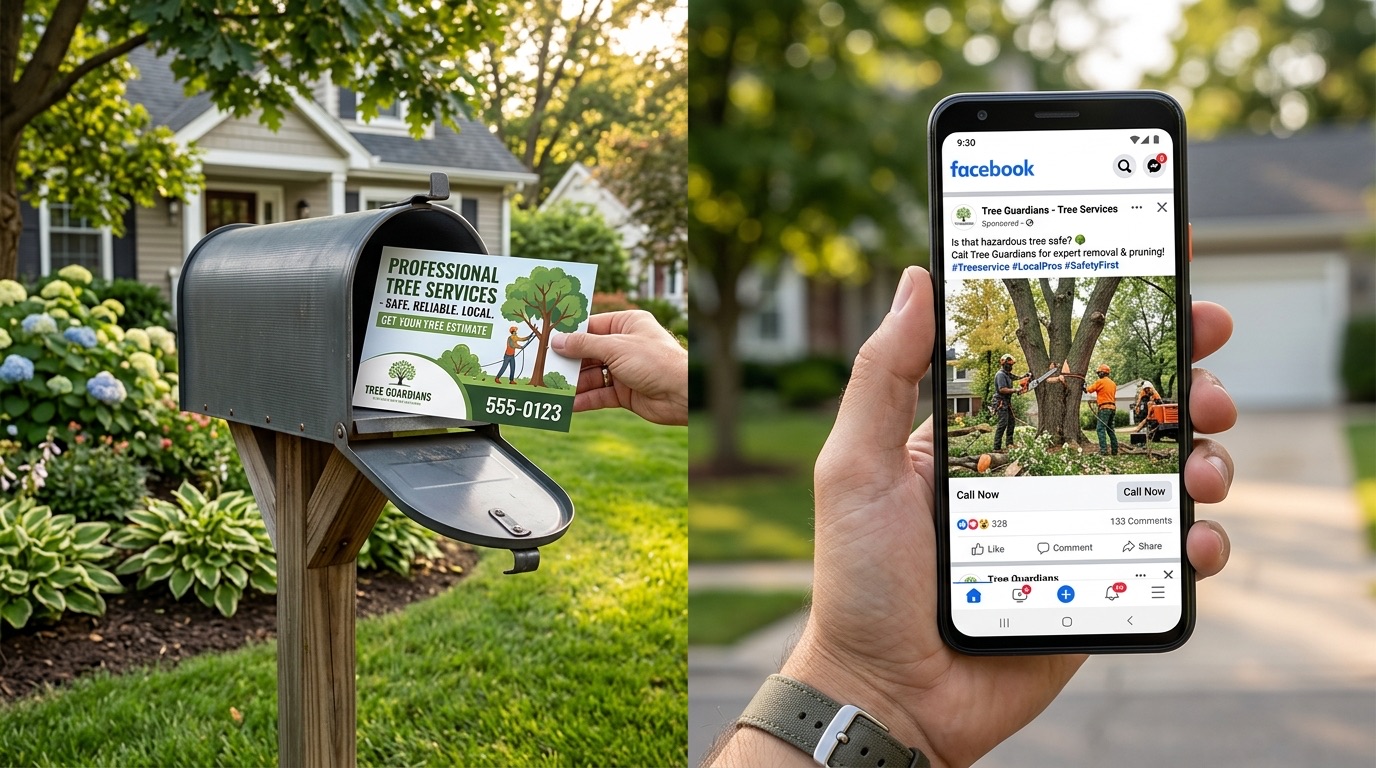
So what’s the alternative? Let’s talk about why a physical letter in a mailbox produces fundamentally different leads than a Facebook ad on a phone screen.
Intent is built into the format. When a homeowner pulls your mailer out of the mailbox, reads it, and calls the number, that’s a deliberate action. They didn’t accidentally tap a button. They picked up a phone and dialed. That’s a completely different level of purchase intent than an auto-filled Facebook form.
Trust favors physical mail. Vericast’s 2024 Direct Mail Influence Report found 58% of consumers say direct mail is trustworthy, and 50% say they typically buy after seeing a direct mail ad compared to 43% after a digital ad. For a $5,000 to $15,000 tree removal, trust matters. A lot.
Mail stays. The average piece of direct mail stays in a home for 17 days. A Facebook ad disappears the second they scroll past it. Your mailer sits on the kitchen counter, on the fridge, next to the phone. When the homeowner finally decides to get that dead oak looked at, your number is right there.
Geographic precision creates operational efficiency. With targeted direct mail, your calls cluster in specific neighborhoods. Matt Morovic with Upright Tree Care runs 5 estimates in 2 hours because they’re all in the same area. Try getting that kind of geographic control from Facebook’s targeting.
Use these differences to decide whether a channel fits the kind of demand you need to create.
| Decision factor | Facebook ads | Targeted direct mail |
|---|---|---|
| Buying unit | Impression, click, or form submission | Letter at $0.52-$0.70 per piece |
| Homeowner context | Scrolling a social feed | Handling a physical message at home |
| Call exclusivity | Form may precede more shopping | Homeowner dials the tree company on the letter |
| Targeting stability | Depends on platform audiences and policy | Fixed carrier routes scored on 295 data points |
| Optimization signal | Campaign and creative conversion | Call performance for each carrier route |
Let’s do the math side by side.
Facebook Ads (typical tree service campaign):
Direct Mail (Tree Traction Growth plan):
The close rate difference is what kills Facebook’s math. When your leads come from homeowners who deliberately called after reading a physical letter, and you’re the only tree company they’re talking to, the close rate isn’t even in the same universe as a cold Facebook form fill.
Lars Kangas with Kangas Tree Service quoted $76,000 and closed $61,000 in his first six weeks with direct mail. His exact words: “The leads are very, very serious leads and 99% of them want tree work.” Compare that to Facebook leads where half don’t answer the phone.
Here’s something Facebook will never give you. With route-level tracking, every single carrier route gets its own phone number. After your first mailing, you know exactly which neighborhoods produce calls and which ones don’t.
Our data across 250+ tree service companies shows that 75% of calls come from just 50% of routes mailed. That means half your routes are carrying the weight. Month two, you cut the dead weight and double down on winners. Your cost per lead drops. Your call volume goes up. Results actually improve over time.
With Facebook, there’s no equivalent feedback loop. The algorithm decides who sees your ad based on its own optimization goals (form fills), not yours (booked jobs). You can’t tell it “stop showing my ad to tire kickers and start showing it to homeowners with $200,000 houses and 80-foot oaks in the backyard.”
With direct mail, that’s exactly what you do. Using 295 data points per carrier route (including satellite tree density data that no one else has), you mail the neighborhoods where homeowners have money and trees. Not everyone on Facebook within 25 miles of your shop.
If you’re spending $1,500 to $3,000 a month on Facebook ads and wondering why your close rate is in the gutter, it’s not your sales skills. It’s the channel.
You don’t have a closing problem. You have a lead quality problem.
The fix isn’t a better Facebook agency or a fancier ad creative. The fix is reaching homeowners who actually need tree work, in neighborhoods where they can afford to pay for it, before they ever start Googling or scrolling Facebook. That’s what direct mail does that digital marketing can’t.
Want to know which specific neighborhoods and routes make sense for your tree service? We’ll map it out with real tree density and demographic data. No obligation, no pressure, and you’ll walk away knowing exactly where your best leads are hiding, whether you work with us or not.
Ready to grow into the neighborhoods you want?
250+ tree companies use Tree Traction. See if your zip code is available.
Book a Free Strategy CallFREQUENTLY ASKED QUESTIONS
Facebook ads can work for brand awareness and retargeting, but they're a poor primary lead source for tree services. Most people scrolling Facebook aren't looking for tree work, so lead quality is low and close rates are typically under 10%.
Facebook's algorithm optimizes for form fills, not buyer intent. Auto-filled lead forms attract tire kickers, free-wood seekers, and people who forgot they submitted the form. The platform has no way to distinguish a $15,000 removal lead from someone wanting a free quote they'll never act on.
Facebook lead costs for home services averaged $34 per lead in 2026, up another 11% from 2025. For landscaping and tree service specifically, benchmarks run even higher at $58 or more per lead. With close rates under 10% on cold Facebook leads, the real cost per booked job routinely lands between $350 and $700.
For generating high-quality, exclusive tree service leads, direct mail consistently outperforms Facebook ads. Direct mail reaches homeowners in targeted neighborhoods with trees, stays in homes an average of 17 days, and generates leads with significantly higher close rates because there's no competition from other tree companies on the same lead.
The most effective tree service marketing combines demand creation (direct mail to targeted neighborhoods) with demand capture (Google LSA or SEO for people actively searching). Facebook works best as a supplemental channel for retargeting and brand awareness, not as your primary lead source.
About the Author
Brayden Fielding
CEO, Tree Traction
Brayden Fielding is the founder and CEO of Tree Traction, the only direct mail company in the U.S. built exclusively for tree service businesses. He's worked with 250+ tree service companies across the country, studying what makes direct mail campaigns produce real revenue (and what makes them flop). When he's not digging into route-level data or reviewing campaign results, he's talking to tree service owners about what's actually working in their markets.
KEEP READING
Direct mail response rate benchmarks for tree service companies, what the 4.4% industry average actually means, and the numbers worth planning a campaign on.
Tired of shared leads? Here are the real Angi, HomeAdvisor, and Thumbtack alternatives for tree service leads, what each one costs, and which fits your size.
Does a tree service guarantee actually close more quotes? What to guarantee, what never to guarantee, and how to write one homeowners believe.
Book a free strategy call — 30 minutes, no obligation.
Book a Free Strategy Call