
Strategy 9 min April 16, 2026 Updated June 25, 2026
7 Tree Service Marketing Mistakes That Are Costing You Jobs

Brayden Fielding
CEO, Tree Traction
Brayden Fielding
CEO, Tree Traction
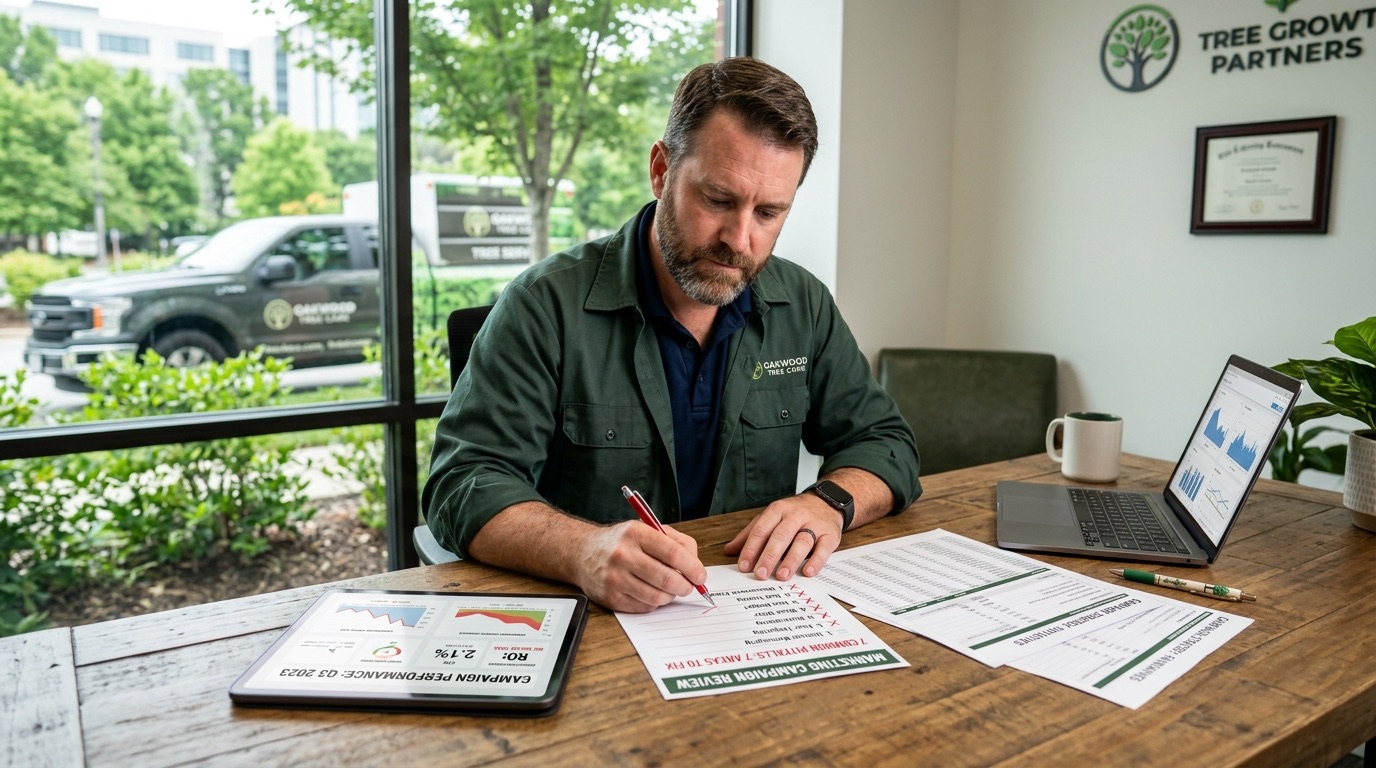
Most tree service marketing mistakes don’t look like mistakes at the time. They look like reasonable, cautious decisions. Testing the waters before committing. Not getting burned again. Keeping options open.
But the result is the same: wasted money, missed jobs, and a phone that rings when it feels like it instead of when you need it to.
Here are the 7 mistakes that cost tree service owners the most. Odds are you’re making at least two of them right now.
The most common mistake in tree service marketing isn’t picking the wrong channel. It’s underspending on the right one.
A tree service at $750K in annual revenue should be spending 5-8% of revenue on marketing, $3,100 to $5,000 a month. Most are spending $800 to $1,500.
Here’s why this kills results: every marketing channel has a minimum threshold of spend required to produce meaningful data and consistent volume. Below that threshold, you’re not running a marketing program, you’re running an experiment at such low stakes that you can’t learn anything from it.
A $700 Google Ads campaign doesn’t give you enough clicks to optimize. A $600 direct mail drop to one carrier route doesn’t give you enough calls to build a pattern. A $300 Facebook budget doesn’t run long enough to know if the audience is right.
Underspending looks like “being careful.” It’s actually the most expensive thing you can do, because you spend enough to distract yourself from finding something better without ever spending enough to get real results.
Run the actual budget math for your revenue level before you decide what to spend.
Month 1 results are the worst your campaign will ever perform. No route data, no creative testing, no optimization. If you judge direct mail at week 6, you’re judging a system before the feedback loop has run a single cycle.
Most tree service owners who say “I tried direct mail and it didn’t work” tried it for one or two months. That’s not a fair test of direct mail, that’s a fair test of month 1 direct mail, which is designed to generate data, not optimized performance.
The same applies to Google Ads, Facebook, and LSA. Any channel that has a learning or optimization period needs at least 90 days of consistent data before you draw conclusions. Quit at 45 days and you’ve paid for the runway without taking the flight.
Set a 90-day evaluation window before you decide whether a channel works. What you see at month 3 is the channel’s actual potential, not what you saw in week 4.
A $4,000/month marketing budget split across Google LSA ($1,000), Facebook ($800), Angi ($700), a local radio spot ($500), and direct mail ($1,000) is not a marketing strategy. It’s five experiments running at 20% power.
None of those channels is funded well enough to generate meaningful volume. None will produce enough data to optimize. And when one of them fails (and one of them will) you won’t know if it failed because the channel doesn’t work or because it was underfunded.
Pick one primary channel and put 70% of your budget there. Put 20% in a secondary channel that complements it. Use the remaining 10% to test one thing at a time. When you have real data from two channels, you can make real decisions about expanding.
More channels at low spend = less data everywhere. One channel at serious spend = data you can actually act on.
Angi sends the same lead to 3-5 competitors simultaneously. Their BBB customer reviews average 1.97 out of 5 across 2,311 reviews, driven by complaints about lead quality and billing disputes. Google LSA now has “Get Competitive Quotes,” which routes one homeowner request to multiple tree services at once. And Thumbtack charges per lead regardless of whether you win the job.
Every dollar you spend on shared-lead platforms is a dollar spent to compete in a price war you didn’t start.
The homeowner on Angi isn’t just getting your estimate, they’re getting 4 others, and they’re going to go with whoever is cheapest or responds fastest. Google shut down the LSA mobile app in January 2025, making the management experience worse and leaving contractors with less control over lead disputes. By the time you show up to give a quote, you’ve already lost on price before you say a word.
Channels where you’re the only tree company the homeowner hears from produce better leads, higher close rates, and higher average job values. Direct mail is the clearest example: the letter lands in their hand before they’ve searched anywhere. You’re not competing with anyone. You’re just having a conversation.
The comparison between shared leads and exclusive leads explains the math in detail.
If you can’t tell where each call came from, you can’t tell what’s working.
Most tree service owners track leads the same way: “how’d you hear about us?” The homeowner says “I saw your truck” or “I found you online” or “a mailer I think?” and you write it down or don’t. After 3 months you have a vague sense of which channels “seem” to be working, but no actual data to make decisions from.
Real tracking means:
When you have that data, marketing decisions stop being guesses. You can see that Route 14 produced 8 calls last month and Route 22 produced zero, and you can cut Route 22 and add Route 14’s budget to a new territory. You can see that Google LSA closes at 28% and Facebook closes at 11%, and allocate accordingly.
Without tracking, you’re flying blind. With it, you’re optimizing a system.
Word-of-mouth is a result, not a strategy. You can’t turn it up when the phone is slow. You can’t predict when it spikes. You can’t control which neighborhoods it comes from or what job types it generates.
Referrals are great. They close fast, they trust you already, and they’re often worth more than an average cold lead. But they’re not a lead system, they’re a bonus on top of a lead system.
Tree service companies that depend primarily on word-of-mouth experience feast-or-famine cycles exactly because they have no controllable volume underneath the organic wave. When business is busy, referrals flow. When it slows, they dry up too.
Build a marketing channel you control, one where you choose how many leads to generate and when. Let word-of-mouth compound on top of that baseline. But never confuse a channel you can’t control with a marketing strategy.
The worst time to start marketing is when the phone stops ringing.
It takes 10-14 days for direct mail to hit mailboxes after you commit. It takes 30-60 days for Google Ads to build optimization data. It takes 2-3 months for direct mail to start compounding. If you wait until November to fix a slow-season problem, you’ve already missed the window.
The tree service companies that never have bad slow seasons aren’t lucky, they’re marketing in September when things are still good. Their campaigns are already running when November hits. Their route data is already building. Their letters are already in homeowners’ hands.
You can’t buy back the weeks you didn’t mail. Every gap in your marketing cadence is a gap in your call volume 2-4 weeks later. The companies that market consistently (every month, not just when they’re worried) never experience the panic of a phone that went quiet.
The best time to start is when you don’t need it. The second best time is today.
See what consistent, predictable lead flow looks like when marketing runs as a system instead of a reaction.
If any of these describe your current setup, the fix isn’t complicated. It usually starts with picking one channel, committing the right budget, and actually tracking results. Schedule a call if you want to talk through what that looks like for your market.
Ready to grow into the neighborhoods you want?
250+ tree companies use Tree Traction. See if your zip code is available.
Book a Free Strategy CallFREQUENTLY ASKED QUESTIONS
The biggest are: underspending on marketing (staying at 1-2% of revenue instead of 5-8%), evaluating channels too early and quitting before the data builds, splitting budget across too many channels at low spend, relying entirely on uncontrollable sources like word-of-mouth, and not tracking where leads actually come from. Any one of these can kill otherwise solid marketing.
Usually because they're on the wrong channels, underfunding the right ones, or not tracking results at the route or campaign level. A tree service spending $800/month split across Google, Facebook, and Angi doesn't have a real marketing strategy, it has three underfunded experiments. None will produce enough data to optimize, and none will produce enough volume to matter.
You need tracking at the source level, not just total leads, but where each lead came from. For direct mail, that means unique phone numbers per carrier route. For Google, it means UTM tags and call tracking. If you can't tell which channel or neighborhood generated each call, you can't tell if your marketing is working or just occasionally lucky.
For companies at $750K+, usually yes. Angi sends the same lead to 3-5 competitors simultaneously, by the time you respond, you're in a price war. The leads that close are typically lower value because Angi attracts price-conscious homeowners. At $25-85 per shared lead, the cost per closed job is high relative to channels where you're the only company the homeowner hears from.
Waiting to market until the phone stops ringing. The best time to start marketing is when you're already busy. That 60-90 day lead time (before results compound and before the data builds) is runway you don't want to burn during a slow season when you desperately need calls. Companies that market consistently don't experience feast-or-famine; companies that market reactively do.
About the Author
Brayden Fielding
CEO, Tree Traction
Brayden Fielding is the founder and CEO of Tree Traction, the only direct mail company in the U.S. built exclusively for tree service businesses. He's worked with 250+ tree service companies across the country, studying what makes direct mail campaigns produce real revenue (and what makes them flop). When he's not digging into route-level data or reviewing campaign results, he's talking to tree service owners about what's actually working in their markets.
KEEP READING
Out-of-town storm chasers flood your market after every big blow. Here is how a local tree service wins those storm leads on trust, speed, and timing.
AI search is how homeowners find contractors now. What ChatGPT reads before it names a tree service, and the trust signals worth fixing this month.
A tree service keywords guide built on real 2026 cost-per-click data: what each search term is worth, what it actually books, and where it belongs.
Book a free strategy call — 30 minutes, no obligation.
Book a Free Strategy Call