
Growth 10 min April 6, 2026 Updated September 19, 2026
Exclusive Tree Service Leads: How to Get Calls Nobody Else Gets

Brayden Fielding
CEO, Tree Traction
Brayden Fielding
CEO, Tree Traction
Alissa Tooley with A&J Specialties closed $69,200 in tree work over three months from mailer leads. Not a single one of those leads was shared with another company. Every call that came in? Hers alone.
Now compare that to your last month on Angi. How many of those leads did you actually close? And how many went to the lowest bidder two towns over?
That’s the difference between exclusive tree service leads and the shared-lead hamster wheel most tree service owners are stuck on. And if you’re tired of driving 45 minutes to give an estimate for someone who already has four other quotes, this is the post that’ll show you how to fix it.
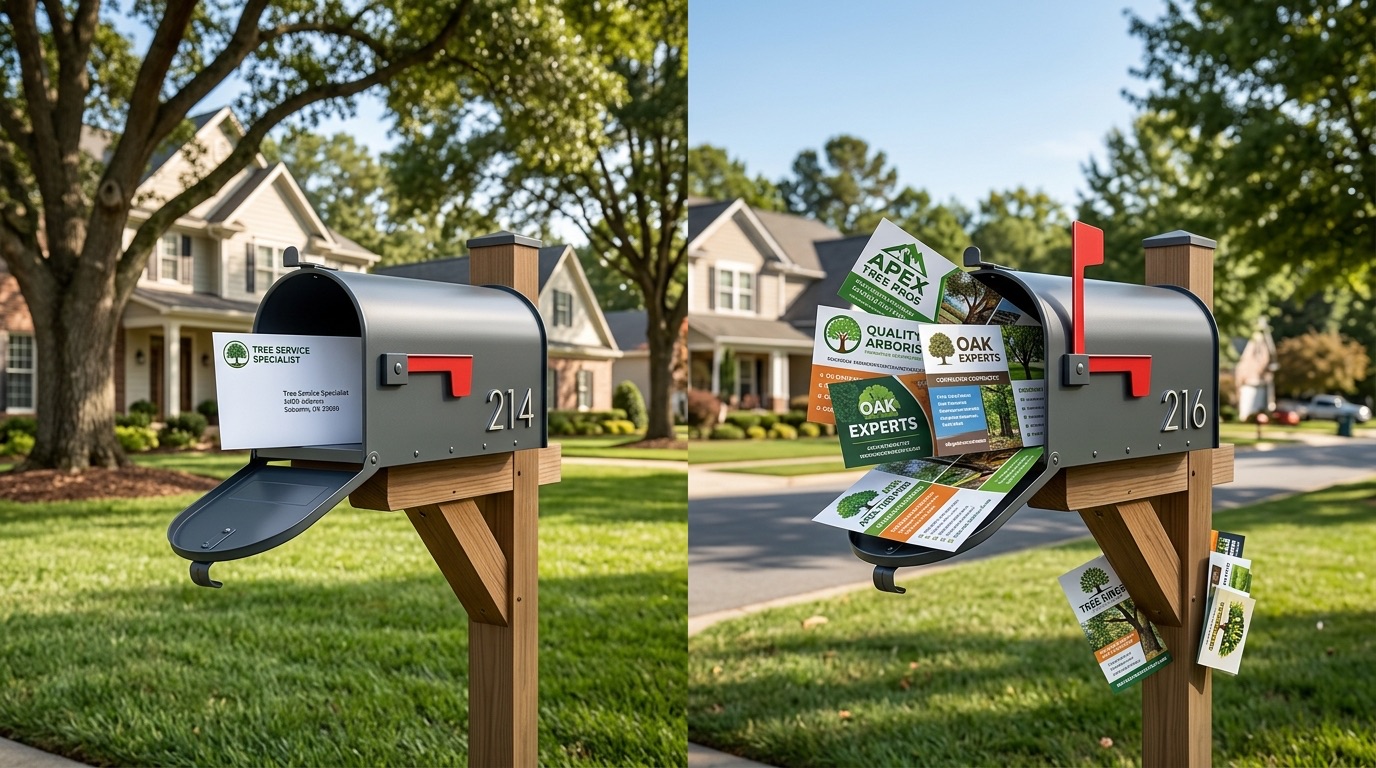
Here’s what happens when you buy a shared lead from Angi, Thumbtack, or Google LSA. The homeowner submits a request. The platform sends that request to 3-5 tree service companies simultaneously. Everyone gets charged. Everyone calls. And the homeowner picks whoever is cheapest or fastest.
You’re not selling tree work at that point. You’re in an auction.
And the close rate follows the math. When four companies quote the same job, one of you books it, so the shared-lead close rate is capped by arithmetic before you ever open your mouth. When you’re the only number that homeowner has, your close rate is decided by your pricing and your presentation, which are things you actually control.
That’s not a marginal difference. That’s the difference between a profitable month and scrambling to cover payroll.
And it gets worse. Google’s “Get Competitive Quotes” feature now lets homeowners request quotes from up to four tree services with a single click. Every company gets charged for that lead. Every company shows up to give an estimate. One company gets the job. Three companies wasted their afternoon.
Sound familiar?
Most tree service owners look at the per-lead price and stop there. A shared marketplace lead is cheaper per lead than an exclusive one through direct mail or a pay-per-lead service. That part is true.
It’s also the wrong number to compare. The one that matters is cost per booked job, and close rate drives it.
Start with arithmetic instead of somebody’s claimed percentage. When a marketplace sends the same request to four companies, at most one of the four books the work. So across everyone who paid for that lead, the average close rate cannot exceed 25% no matter how good your sales process is, and that ceiling drops further every time the homeowner decides to wait, do it themselves, or hire nobody.
An exclusive call has no such ceiling. Your close rate is set by your pricing and your presentation.
Run it on your own numbers. Take what you paid for leads last month, divide by the jobs you actually booked from them, and compare that figure across sources. A channel at triple the cost per lead still wins if it books at three times the rate, and most owners have never done that division.
There’s a second cost nobody puts on the spreadsheet: your time. Every shared lead you chase means driving out to quote a job where the homeowner is holding three other numbers. That’s 60 to 90 minutes gone, and when the marketplace pulls requests from everywhere in your service area, those hours stack up fast.
Let’s talk about the platforms that sell shared tree service leads and why the model doesn’t work in your favor.
Angi sends the same lead to 3-5 contractors at once. Their BBB customer reviews average 1.97 out of 5 across 2,311 reviews, and the complaints run in both directions: homeowners unhappy with the contractors, contractors unhappy with the billing. Contractor reviews consistently describe most Angi leads as unqualified: people who don’t answer, aren’t serious about hiring, or have no idea they were contacted. You’re paying for calls from people who want a $150 trim or free wood removal.
Thumbtack charges you when a homeowner contacts you, whether or not that homeowner ever intended to hire anybody. Multiple contractors get charged for the same request, so the platform collects several times on a job that only exists once.
Regulators have looked at this model. The FTC ordered HomeAdvisor to pay up to $7.2 million and stop deceptively marketing its leads to service providers, citing claims about lead quality and match rates that did not hold up. Read the complaint and the pattern is familiar to anyone who has bought marketplace leads: the volume was real, the intent was not.
Google LSA used to be better. But the “Get Competitive Quotes” feature turned it into another shared-lead platform. You’re now competing directly against other tree services in the same search result, and Google charges each of you for that lead.
The business model of these platforms depends on selling the same lead multiple times. That’s how they make money. Your close rate isn’t their problem.
Compare each source by who receives the call and what marketing asset remains afterward.
| Call source | Exclusive at first contact? | Asset you own | Main limitation |
|---|---|---|---|
| Past-customer referrals | Usually | Customer relationship | Volume is unpredictable |
| Google Business Profile | Usually | Reviews and profile history | Rank and demand vary by location |
| Targeted direct mail | Yes | Tracking numbers and route history | Requires consistent mailing and follow-up |
| Door-to-door outreach | Yes | Neighborhood familiarity | Labor-intensive and hard to scale |
| Shared marketplace | No | Little beyond your own notes | Price competition begins immediately |
So how do you build a lead pipeline where every call is yours alone? Here are the channels that actually produce exclusive leads for tree service companies.
When a handwritten-style letter lands in a homeowner’s mailbox, you’re the only tree company they’re hearing from. There’s no platform in the middle selling that same lead to your competitor across town.
This is where route-level tracking changes the game. Instead of blanketing an entire zip code and hoping for the best, you track which specific carrier routes produce calls and which don’t. Then you cut the dead weight and double down on what works.
There’s a second benefit that shows up in your calendar rather than your ad spend. Because mail concentrates volume into chosen neighborhoods, the calls arrive geographically clustered, which means several quotes in one afternoon instead of a day spent driving. Try doing that with Angi calls scattered across three counties.
Your best customers already know other homeowners with trees. A structured referral program (not just “tell your friends”) turns every completed job into a lead source. Offer a gift card or discount on future work for every referral that books.
These leads close at the highest rate of any channel because trust is already built. The homeowner heard about you from their neighbor who watched you take down a 70-foot oak without scratching the fence.
When someone Googles “tree removal near me” and clicks on your website (not an ad, not a directory), that’s an exclusive lead. They found you. They called you. Nobody else.
This takes time to build, but it compounds. And unlike Angi, you own that traffic. Google can’t sell your organic click to four other companies.
Just finished a big removal in a nice neighborhood? Leave door hangers on the 20-30 houses surrounding the job site. Those neighbors saw your crew working, saw the trucks, and now they’ve got a reminder in their hand.
This is the lowest-cost exclusive lead source available. The close rate on “I saw you doing work on my neighbor’s property” calls is exceptional.
A professional yard sign at every job site turns a single job into advertising for the entire block. Your trucks driving through neighborhoods with your number on them create the same effect. These are low-effort, high-return sources of exclusive leads.
Not all exclusive lead sources are equal. Referrals are great but unpredictable. SEO takes months. Door hangers don’t scale.
Direct mail is the only exclusive lead channel that’s both scalable and trackable from day one.
Here’s why it works so well for tree service companies specifically. You’re mailing into neighborhoods where homeowners have money, property, and trees. You know this because the targeting uses 295 data points per carrier route, including satellite tree density analysis. You’re not guessing. You’re mailing the neighborhoods most likely to need a removal, a trim, or storm cleanup.
And because each carrier route gets its own tracking phone number, you know exactly which neighborhoods are producing calls. Across our client base, roughly 75% of calls come from about 50% of the routes mailed, which means half of an untracked mail budget is quietly funding neighborhoods that never ring.
Good results aren’t random. They’re the product of mailing the right neighborhoods with the right message at the right time. And every single call is exclusive.
Compare that to what happens when you leave Angi. You walk away with nothing. No phone numbers. No data on which areas produce calls. No history. You rented leads, and when you stop paying, it’s like you never existed.
Here’s the part that makes exclusive tree service leads from direct mail fundamentally different from any platform-based lead source.
Month one, you mail 4,600 letters across two blasts. You get calls. Some routes perform well. Some don’t. That’s expected.
Month two, you cut the underperforming routes and shift that mail volume to the routes that produced calls. Your cost per lead drops. Your call volume goes up from the same spend.
Month three, you’re refining again. Testing new creative. Adjusting messaging for the season. Your ROI keeps improving because you have actual data on what works in your specific market.
This is why roughly 75% of client calls come from just 50% of routes mailed. If you’re doing EDDM on your own or using a cheap provider with no tracking, you’re paying full price to mail the dead routes forever. You’d never know which half is working and which half is wasted money.
That feedback loop doesn’t exist on Angi. It doesn’t exist on Thumbtack. And it definitely doesn’t exist with DIY EDDM.
“Exclusive” is a word anybody can print on a website, so the useful comparison is not the label. It’s what you pay per call, who else gets that call, and what you still own if you stop paying next month.
| Channel | Typical cost per call | Who else gets the call | What you keep if you leave |
|---|---|---|---|
| Shared marketplace (Angi, Thumbtack) | $25 to $85 | 3 to 5 competitors | Your own notes, nothing else |
| Google LSA | $50 to $150 | Whoever else the homeowner clicks | Nothing, the profile is Google’s |
| Pay-per-lead mail (they own the number) | Around $85 | Nobody | Nothing, the number goes with them |
| Targeted direct mail (you own the number) | $40 to $140 | Nobody | Numbers, route data, call history |
| Referrals and past customers | Cost of the incentive | Nobody | The relationship |
Notice that two rows look identical on exclusivity and land in completely different places on ownership. That is the distinction almost nobody makes when they shop for exclusive tree service leads.
A pay-per-lead mail provider genuinely does send you a call nobody else got. But the tracking number printed on that mailer is theirs. Every call that ever came through it lives in their system, and the day you leave, you cannot take the number, the call history, or the knowledge of which neighborhoods produced work. You rented exclusivity for a month at a time.
That’s the question worth asking before you sign anything: exclusive to whom, and for how long?
There’s a second word that gets thrown around in this conversation, and owners regularly buy one thinking they got the other.
Lead exclusivity means this call is yours alone. Territory exclusivity means a competitor cannot buy into your area from that provider at all. Plenty of companies offer one and let you assume both.
| What’s promised | What it actually prevents | What it does not prevent | Who sells it this way |
|---|---|---|---|
| Lead exclusivity only | This specific call going to a competitor | That same provider mailing your competitor into the next zip over | Pay-per-lead mail, call brokers |
| Territory exclusivity only | A competitor buying your zip codes from that provider | Calls being shared or resold within the program | Some regional mail vendors |
| Both, reserved by zip code | Competitors buying your area, and calls being split | Competitors reaching those homes through Google or their own mail | Zip-code-reserved direct mail |
| Neither | Nothing at all | Everything | Angi, Thumbtack, Google LSA |
Row three is what a reserved zip code actually buys, and it’s worth being precise about the limit.
Exclusivity with a mail provider is exclusivity inside that provider’s program. It does not put a fence around the neighborhood, and any competitor can still run ads into your zip code tomorrow. What it stops is the thing owners rarely think to ask about: paying a company that is mailing your closest competitor into the same carrier routes the same week.
Two nearly identical letters in one mailbox is how you train a whole neighborhood to shop price.
So ask any provider two questions before you sign. How many tree services are you currently working with within 30 miles of me, and what exactly is reserved, the zip codes, the individual carrier routes, or nothing?
The second answer tells you whether “exclusive” means anything on that contract.
Not every “exclusive lead” offer is actually exclusive. Before you invest in any lead channel, ask these questions:
Do you own the phone number? If the lead company owns the tracking number on your mailer or ad, they own the relationship. You leave, you lose everything. Make sure you own and can port every number.
Can you see where the leads come from? Route-level or neighborhood-level data is the minimum. If a provider can’t tell you which specific areas produce calls, they’re just printing and mailing. There’s no optimization happening.
Is there a feedback loop? Results should improve month over month. If your lead cost and volume are flat after 3-4 months, the system isn’t learning. It’s just repeating.
Are your leads geographically clustered? Exclusive leads that come from all over your service area still waste your time. The best exclusive lead sources concentrate calls so you can run multiple estimates in a single trip.
The tree service owners who are growing fastest right now aren’t the ones buying the most leads. They’re the ones who’ve figured out that the source of the lead matters more than the volume.
Exclusive leads close faster. They pay better. They don’t turn every estimate into a bidding war. And when they come from a system with route-level tracking and optimization, they get cheaper over time.
Pick one channel from the cost comparison where the call arrives with your name on it and nobody else’s. Build it until it produces reliably. Then let your shared-platform spend shrink on its own, because you no longer need the volume badly enough to pay for a price war.
Your move. Want to see which routes would produce the best exclusive leads in your area? We’ll map it out for free.
Ready to grow into the neighborhoods you want?
250+ tree companies use Tree Traction. See if your zip code is available.
Book a Free Strategy CallFREQUENTLY ASKED QUESTIONS
An exclusive lead goes to one tree service company only. A shared lead gets sent to 3-5 competitors at the same time. Exclusive leads close at a materially higher rate because you're the only company the homeowner is talking to, so you're competing on your own pricing and presentation rather than against three other quotes.
It depends on the source. Pay-per-lead mail providers charge around $85 per call and keep the tracking number. Google LSA runs $50 to $150. Targeted direct mail where you own the number lands between $40 and $140 per call depending on your market and how far along the route data is.
Shared leads turn every estimate into a price war. The homeowner already has 3-4 quotes before you show up. You end up competing on price instead of quality, driving margins down and wasting hours on estimates that don't close.
Yes. When your mailer lands in a homeowner's mailbox, you're the only tree service company they're hearing from, and no platform is sending that same lead to your competitors. Ask whether the provider also reserves your zip codes, though. Lead exclusivity and territory exclusivity are separate promises, and some providers only offer one.
You can reduce your Angi and Thumbtack spend and redirect that budget into exclusive lead channels like direct mail, SEO, or referral programs. The key is building lead sources you own and control rather than renting them from platforms that sell the same lead to multiple contractors.
About the Author
Brayden Fielding
CEO, Tree Traction
Brayden Fielding is the founder and CEO of Tree Traction, the only direct mail company in the U.S. built exclusively for tree service businesses. He's worked with 250+ tree service companies across the country, studying what makes direct mail campaigns produce real revenue (and what makes them flop). When he's not digging into route-level data or reviewing campaign results, he's talking to tree service owners about what's actually working in their markets.
KEEP READING
Tree service businesses sell for 2x to 4x SDE. Here's what sets the multiple, what buyers discount hardest, and why owning your call data raises the number.
Crane tree removal jobs pay several times a standard takedown. Here's how to find the neighborhoods holding those trees and get the phone to ring.
What tree service online reputation management actually covers, what the agencies charge for it, and which parts you can run yourself in a few minutes a week.
Book a free strategy call — 30 minutes, no obligation.
Book a Free Strategy Call