
Industry 10 min March 30, 2026 Updated August 16, 2026
Why Tree Service Owners Are Leaving Angi in 2026

Brayden Fielding
CEO, Tree Traction
Brayden Fielding
CEO, Tree Traction
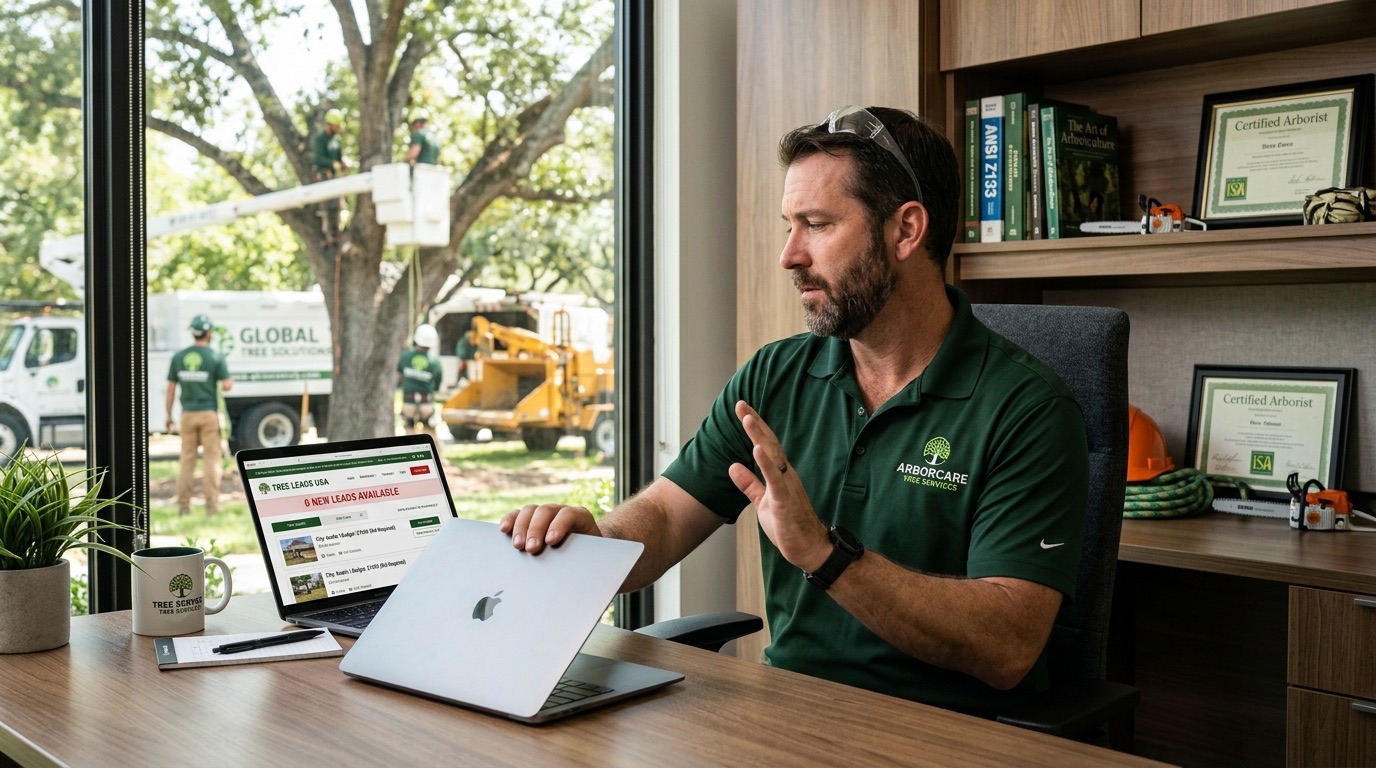
Across the 250+ tree service companies we’ve worked with, we hear the same Angi complaint: one homeowner request goes to several contractors, so owners pay to enter a speed-to-call and price race.
Here’s what’s actually happening on the platform, why so many tree service owners are leaving Angi in 2026, and what the smart operators are doing instead.
This is the core problem with Angi, and it’s baked into their business model. When a homeowner submits a request for tree removal or trimming on the platform, Angi doesn’t send that lead to one contractor. They sell it to three, four, sometimes five or more companies simultaneously.
A BBB complaint from a contractor states it plainly: “The lead was sent to 5 contractors at the exact same second.”
Think about what that means for your day. You get the notification, drop what you’re doing, call the homeowner back within five minutes (because speed matters on shared platforms), and find out they’ve already scheduled an estimate with someone cheaper. Or they don’t pick up at all because four other contractors beat you to it.
You’re not competing on the quality of your work. You’re competing on who calls back fastest and who quotes the lowest number. That’s a race to the bottom, and it has nothing to do with running a good tree service.
Shared leads would be one thing if the people on the other end were serious about getting tree work done. They’re not.
Contractor reviews on Trustpilot describe the same pattern over and over: leads who don’t answer the phone, aren’t serious about hiring, or have no idea they were contacted. Some contractors believe Angi manufactures leads, because so often you can’t even reach the person. When you do get through, they sometimes have no clue what you’re talking about.
One long-time contractor who spent 12 years on the platform said the leads are “increasingly less in volume and the quality of leads are pathetic.” That tracks with what we hear on our sales calls every week. Tree service owners tell us they’re paying $50 to $85 per lead on Angi, and most of those leads want a $150 trim job, aren’t home when you show up, or were just browsing.
Sound familiar?
Here’s the thing about Angi’s model: it attracts a specific type of homeowner. Someone who goes to a platform knowing they’ll get multiple quotes is, by definition, shopping on price.
These aren’t the homeowners with a 60-foot dead oak leaning over their garage who need it handled this week by a crew they trust. Those homeowners ask a neighbor, check Google, or call the company whose letter is sitting on their kitchen counter. They want the job done right, and they’re willing to pay for it.
Angi homeowners want the cheapest number. Contractors on the platform describe them as “broke homeowners who can’t and won’t afford the average going rate.” When you’re bidding against four other tree services for a price-conscious buyer, your margins disappear. Your close rate drops. And the jobs you do win aren’t the $3,000 to $8,000 removals that actually move the needle for your business.
They’re the $400 trim jobs that barely cover the gas to get there.
If you want to know how a company treats its partners, check the BBB. Angi averages 1.97 out of 5 across 2,311 customer reviews, and the company is not BBB accredited. That is under two stars from more than two thousand people.
The complaints paint a clear picture:
This isn’t a platform that’s aligned with your success. It’s a platform designed to lock you in and keep billing you whether the leads produce jobs or not.
Angi doesn’t just send you bad leads. They send you the wrong leads.
Tree service contractors report getting job requests that have nothing to do with their actual services. You’re a removal specialist and they send you a hedge-trimming request. You only do residential work and they send you a commercial bid 45 minutes outside your service area. You quoted a stump grind and the homeowner actually wanted a full yard cleanup.
The platform doesn’t understand what you do, what you’re good at, or where you work. It just matches keywords and sends leads to whoever’s paying.
On top of that, Angi’s contractor vetting is thin. A Suffolk County, New York Consumer Affairs Department representative stated that Angi’s “professional contractors are not screened in any way, shape, or form.” When unvetted competitors are getting the same leads you are, and they’re quoting half your price because they don’t carry insurance or workers’ comp, you lose twice. You lose the job, and you lose it to someone who shouldn’t be in the market.
Here’s a risk most tree service owners don’t think about until it’s too late. On Angi, homeowners can leave reviews on your profile, and you have limited ability to dispute them.
That means a price shopper who got five quotes, went with the cheapest unlicensed guy, and then came back to leave a one-star review on your profile because you “charged too much” is now affecting your reputation on a platform you’re paying to be on. You didn’t do their job. You didn’t even meet them. But their review sits on your profile, dragging down your rating.
When you control your own marketing (your mailers, your phone numbers, your neighborhoods), you control the customer experience from first impression to completed job. On Angi, you’re renting space on someone else’s platform and hoping the reviews work out.
If you were waiting to see if Angi would improve, the 2026 data doesn’t give you a reason to wait. Contractor forums as of early 2026 are reporting the same complaints louder: lead volume is down, lead quality is worse, and trying to cancel is a full-time job. One contractor in a major home services forum described calling four times to cancel before getting any response. Another said they were billed for 60 days after their supposed cancellation date.
Angi introduced “Quick Match” features that claim to speed up lead delivery, but contractors in tree service forums say it just means the same low-quality lead hits your phone faster. You still close 10-15% of them. You still split them with three other companies. And you still pay $50-$85 for the privilege.
The lead cost math in 2026: at $85/lead, a 12% close rate, and 30 leads per month, you’re spending $2,550 to book roughly 4 jobs. If your average job is $1,500, that’s $6,000 revenue on $2,550 in lead spend. 2.4x return, before you account for drive time on the 26 estimates that went nowhere. For a company running professional crews at $150K+ per truck annually, that math doesn’t work.
So if Angi doesn’t work, what does? The tree service companies we work with who’ve left Angi and switched to targeted direct mail share a few things in common.
They wanted exclusive leads. Not shared with four competitors. Not a bidding war. They wanted to be the only tree service company that homeowner called.
Lars Kangas with Kangas Tree Service quoted $76K in jobs and closed $61K in his first six weeks with direct mail. His words: “The leads are very, very serious leads and 99% of them want tree work. When you try other marketing companies people call you for random stuff like cleaning your yard and crap. All of these want real tree work.”
That’s the difference between a platform that sells your lead to five people and a letter that lands in one homeowner’s hand before they’ve talked to anyone else.
Worth knowing before you cancel anything: HomeAdvisor and Thumbtack run the same shared mechanic under different branding, so hopping between them changes the invoice and nothing else. We compared every Angi, HomeAdvisor, and Thumbtack alternative for tree service leads and laid out how to switch without going dark for a quarter.
Dayde Collins with Blades Tree Removal in Provo, Utah, quoted $47K in 30 days and closed $25K. He said Tree Traction outperformed all previous digital marketing and agencies he’d tried. That includes Angi.
Every major complaint about Angi has a direct mail counterpart that solves it. Here’s how the mechanics actually work.
Shared leads? With direct mail, there are no shared leads. Your letter goes to a homeowner. They call the number on the letter. That number rings your phone. Nobody else got that lead. Your close rate goes up because you’re not in a price war before the conversation even starts.
Unqualified prospects? Direct mail targets specific neighborhoods using demographic data, property values, and (in Tree Traction’s case) satellite tree density analysis. You’re reaching homeowners with money, property, and trees. Not random browsers on a website.
Price shoppers? When someone calls you from a letter on their kitchen counter, they haven’t requested quotes from four other companies. They haven’t even searched Google yet. You’re the only tree company they’re talking to. That changes the entire dynamic of the estimate.
No data on what’s working? Route-level tracking gives you a unique phone number for every carrier route. You know exactly which neighborhoods produce calls and which don’t. Cut what’s not working, scale what is. Your cost per lead drops month over month, not stays flat.
Someone else controls your reputation? With direct mail, you own the phone numbers, the data, and the campaign history. If you ever leave, you take everything with you. Port your numbers for $1.25 each. The asset you built is yours.
The structural differences explain why two similar call prices can produce very different acquisition costs.
| Decision factor | Angi | Targeted direct mail |
|---|---|---|
| Contact distribution | Often sent to multiple contractors | Homeowner calls the company on the letter |
| Buying unit | Membership or homeowner contact | Letter at $0.52-$0.70 per piece |
| Price pressure | Built into the comparison process | Begins only if the homeowner shops afterward |
| Geographic learning | Broad service-area history | Call results tied to each carrier route |
| Asset after cancellation | Platform access ends | Owned numbers and route history remain |
Let’s talk numbers, because this is where it gets obvious.
On Angi, tree service leads cost $25 to $85 each. They’re shared with 3-5 competitors. Close rates on shared leads typically run 10-15% (being generous). That puts your cost per booked job somewhere between $200 and $850 on the low end, and well over $1,400 in many markets.
With targeted direct mail through Tree Traction, you’re sending letters at $0.52 to $0.70 per piece. A Growth plan runs about $3,200/month for 4,600 letters across two mailings. Because the leads are exclusive and you’re reaching homeowners before they shop around, close rates run significantly higher. And because you’re tracking at the route level with 295 data points per carrier route, results improve month over month instead of staying flat (or getting worse, like Angi).
The math isn’t close. Dollar for dollar, exclusive leads from direct mail outperform shared Angi leads by a wide margin.
If you’re still on Angi, ask yourself this: what do you actually own? Not the leads. Not the phone number. Not the data. Not the reviews. If you cancel tomorrow, you walk away with nothing except a lighter bank account and a year of wasted drive time to estimates that went nowhere.
The tree service owners leaving Angi in 2026 aren’t leaving because they found a cheaper lead source. They’re leaving because they found a better model. One where every lead is exclusive, every neighborhood is tracked, and every dollar they spend builds an asset they own.
Want to see what your direct mail campaign would look like? We’ll map your best routes for free.
Ready to grow into the neighborhoods you want?
250+ tree companies use Tree Traction. See if your zip code is available.
Book a Free Strategy CallFREQUENTLY ASKED QUESTIONS
For most tree service companies, no. Angi sends the same lead to 3-5 contractors simultaneously, creating a price war before you even pick up the phone. Contractor reviews on Trustpilot and BBB describe most Angi leads as unqualified or unresponsive. There are better ways to spend your marketing budget.
Contractors leave Angi because of shared leads sent to multiple competitors, low-quality prospects who are price shopping, billing disputes, aggressive cancellation penalties, and an overall cost per booked job that doesn't make sense. Angi's BBB customer reviews average 1.97 out of 5 across 2,311 reviews, reflecting widespread dissatisfaction from contractors and homeowners.
Angi charges tree service companies between $25 and $85 per lead depending on the job type and market. But because those leads are shared with 3-5 other contractors and the close rate is low, the actual cost per booked job often exceeds $1,400. That's before you factor in the time wasted driving to estimates you were never going to win.
Targeted direct mail is one of the strongest alternatives. Unlike Angi, every lead is exclusive, meaning you're the only tree company that homeowner called. There's no bidding war, no price shopping, and you control exactly which neighborhoods you're targeting. Companies like Tree Traction track results at the carrier route level so campaigns improve month over month.
Yes. Direct mail, referral programs, and strong SEO all generate exclusive leads where you're the only contractor the homeowner contacts. Direct mail is particularly effective because it reaches homeowners before they start searching online or requesting quotes from platforms that share leads with multiple companies.
About the Author
Brayden Fielding
CEO, Tree Traction
Brayden Fielding is the founder and CEO of Tree Traction, the only direct mail company in the U.S. built exclusively for tree service businesses. He's worked with 250+ tree service companies across the country, studying what makes direct mail campaigns produce real revenue (and what makes them flop). When he's not digging into route-level data or reviewing campaign results, he's talking to tree service owners about what's actually working in their markets.
KEEP READING
What Dope Marketing is, whether DOPE 360 is software, what the platform costs per tier, and whether the automation fits how a tree service gets leads.
Total US mail volume is falling. Direct mail response rates are rising. Here's what the 2026 numbers actually mean for tree service marketing.
Real revenue, profit margin, and owner take-home data for tree service businesses in 2026, broken down by company size, service mix, and local market.
Book a free strategy call — 30 minutes, no obligation.
Book a Free Strategy Call