
Strategy 16 min March 30, 2026 Updated September 28, 2026
Best Marketing for Tree Service Companies: 2026 Comparison

Brayden Fielding
CEO, Tree Traction
Brayden Fielding
CEO, Tree Traction
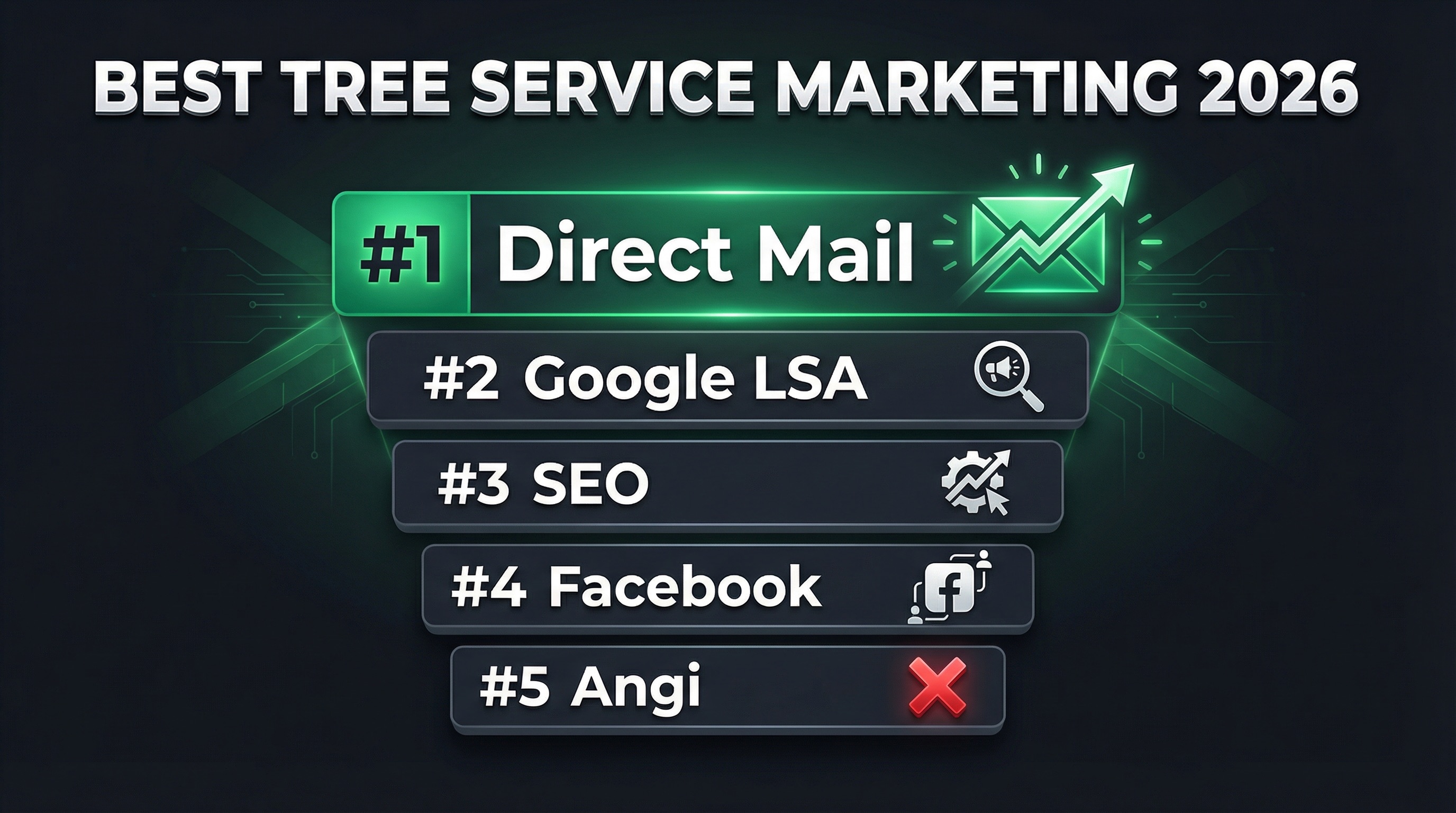
The best marketing system for most established tree service companies combines targeted direct mail for exclusive calls, Google LSA for active search demand, and SEO for long-term visibility. Start with one measurable primary channel, track cost per booked job for 90 days, and add support channels only after the phone and follow-up process can handle more volume.
You’re spending money on marketing. But do you actually know which channel is putting jobs on your schedule and which one is just burning cash?
That’s the question we hear on nearly every sales call at Tree Traction. After working with 250+ tree service companies over the past five years, we’ve seen owners try everything: Google LSA, Angi, Thumbtack, Facebook ads, SEO, yard signs, vehicle wraps, DIY mailers, and professional direct mail. Some of those channels work. Some used to work. And some are a flat-out waste of money for most tree service businesses.
This is the honest breakdown. Every major marketing channel for tree service companies, compared side by side with real cost data, lead quality ratings, and specific recommendations for who should use what. No fluff, no “it depends on your goals” cop-outs. Just the data.
Google LSA used to be the golden ticket for tree service companies. You’d show up at the top of search results with a “Google Guaranteed” badge, pay per lead, and the phone would ring with homeowners who needed tree work right now.
That’s still partially true. LSA captures the highest-intent leads of any channel because these are people actively searching “tree removal near me” or “emergency tree service.” The intent is real.
Cost range: SearchLight Digital tracked $6.72M of spend across 888 contractors in February 2026 and put the blended home services cost per lead at $53, with a book rate near 44%. Tree work specifically tends to run $25 to $75, with smaller cities at the bottom of that band and major metros at the top.
Lead quality: High intent, but increasingly shared. Google’s “Get Competitive Quotes” feature (rolled out in 2025) now sends a homeowner’s request to up to four tree service companies simultaneously. You’re paying for a lead that three other companies also received.
Pros: Fastest time to first lead of any channel. High purchase intent. Google Guaranteed badge builds trust. Strong analytics.
Cons: Costs rising every year. Algorithm changes can tank your performance overnight with zero warning. Google removed manual lead disputes in 2024, so AI now decides if your lead is valid. The LSA mobile app was shut down in early 2025 and has not returned. An April 2025 TOS update means Google now claims ownership of your LSA ad assets, so your data isn’t fully portable if you switch agencies or pause campaigns. And that “Get Competitive Quotes” feature, now fully entrenched, turned what used to be exclusive leads into shared ones across the board.
Best for: Tree service companies in smaller markets where competition is low and cost per lead stays under $50. Works well as a supplement to other channels, but it’s risky as your only lead source. For a deeper look at the math, check out our full LSA comparison.
Google Ads (pay-per-click) puts you in the search results below LSA listings. You bid on keywords like “tree trimming” or “stump grinding” and pay every time someone clicks.
Cost range: 99 Calls tracked tree service Google Ads from January 2024 through July 2026 and found an average cost per click of $15.11 against a median cost per lead of $85 to $110, rising to $101 to $225 in high-competition markets. At a 30% close rate, that puts cost per booked job north of $300 in an easy market and well past $600 in a hard one.
Lead quality: High intent (they searched for tree service), but you’re competing with every other tree company bidding on the same keywords. Homeowners often click 3-4 ads and request quotes from all of them.
Pros: You can increase budget to increase volume. Highly measurable. Works in any market size.
Cons: Expensive and getting more so every year. Requires ongoing management (or an agency charging $500-$1,500/month on top of ad spend). Click fraud is real. One bad month can eat your entire marketing budget. And you’re always one algorithm update away from your cost per lead doubling.
Best for: Companies with $5,000+ monthly ad budgets who can afford professional management and aren’t relying on PPC as their only channel.
Here’s a question worth asking yourself: when was the last time an Angi lead turned into a premium job?
Angi sends the same lead to 3-5 contractors simultaneously. By the time you show up to give an estimate, you’re in a price war with every other tree service in town. The homeowner already has four quotes and they’re picking the cheapest one.
Cost range: $25-$85 per lead depending on job type. But remember, that’s per shared lead. Contractor reviews on Trustpilot describe a familiar pattern: leads who don’t answer the phone, aren’t serious about hiring, or have no idea a contractor was going to call. Angi’s BBB customer reviews average 1.97 out of 5 across 2,311 BBB customer reviews.
Lead quality: Low. Price shoppers who know they have multiple contractors competing for their business. Mismatched job types are common (getting sent a “trim trees” lead when you specialize in removals).
Pros: Large consumer audience. Low barrier to entry. Can generate volume in some markets.
Cons: Shared leads create immediate price competition. Low-quality homeowners. High percentage of unqualified leads. No exclusivity. Many tree service companies who’ve grown past $500K in revenue have already moved on from Angi.
Best for: Newer tree service companies who need any work they can get and don’t mind competing on price. Not recommended for established companies focused on profitability. See our detailed Angi comparison for the full breakdown, or the full rundown of Angi, HomeAdvisor, and Thumbtack alternatives for tree service leads if you’ve already decided to leave.
Thumbtack works similarly to Angi but with slightly better mechanics. Homeowners submit a project request, Thumbtack matches them with pros, and you pay per lead.
Cost range: $15-$40 per lead for tree service, though Thumbtack uses dynamic pricing that adjusts weekly based on supply and demand. Leads can spike above $60 during busy seasons.
Lead quality: Moderate. Better than Angi on average, but still shared with multiple contractors. Because every pro in the match sees the request at once, the job usually goes to whoever calls back first, which rewards a free phone more than a better crew.
Pros: Lower cost per lead than most digital channels. Large user base. Good for smaller jobs (trims, stump grinds). Decent mobile app for quick responses.
Cons: Still shared leads. Rewards speed over quality. Dynamic pricing means your cost per lead is unpredictable. Homeowners on Thumbtack tend to be shopping for smaller, price-sensitive jobs, not $5,000 removals.
Best for: Companies looking to fill schedule gaps with smaller residential jobs. Not ideal if your average job value is above $1,500 and you want premium clients. Our Thumbtack comparison page goes deeper on the numbers.
Facebook can generate a lot of leads at a low cost per click. That’s the good news.
The bad news? Most of those leads are terrible.
Cost range: $30-$80 per lead for tree service. Cost per click is cheap ($1-$5), but conversion rates are low because people on Facebook aren’t looking for tree service. You’re interrupting them while they scroll past cat videos.
Lead quality: Low to moderate. Facebook’s AI-optimized campaigns (Advantage+) have driven up lead volume but cratered quality across home services in 2024-2025. Multiple tree service owners we’ve talked to describe Facebook leads as “tire kickers and free-wood seekers.” A large share of Meta lead form submissions turn out to be low quality or non-contactable once you actually try to reach them, which tracks with what agencies running Advantage+ campaigns for home services consistently see.
Pros: Low barrier to entry. Creative flexibility (video, carousel ads). Can work in specific markets, particularly rural or suburban areas. Good for brand awareness even if direct lead quality is low.
Cons: Zero purchase intent. Lead quality has gotten significantly worse since Meta shifted to AI-driven campaigns. Costs have tripled for many advertisers with no improvement in close rates. Accounts get suspended without warning. Requires constant creative refresh to avoid ad fatigue.
Best for: Brand awareness campaigns, not direct lead generation. If you run Facebook ads, pair them with a stronger lead gen channel. Don’t make Facebook your primary lead source.
SEO (search engine optimization) means getting your website to rank organically on Google for searches like “tree service near me” or “tree removal [your city].” Your Google Business Profile is the map listing that shows up with reviews.
Cost range: Free if you do it yourself. $1,000-$3,000/month if you hire an agency. Takes 6-12 months to see meaningful results. That’s one line in a much wider band, and we mapped the whole thing in what tree service marketing companies cost and what you get.
Lead quality: Very high. Organic search leads have strong intent, similar to LSA. And they’re free once you rank.
Pros: Highest ROI channel long-term because leads are essentially free. Builds lasting online presence. Reviews on your Google Business Profile are one of the biggest trust signals for homeowners. People who search for a local service tend to act fast, often visiting or calling a business within a day of finding it.
Cons: Slow. You won’t see results for 6-12 months minimum. Google algorithm changes can wipe out your rankings overnight. Requires ongoing content creation and technical maintenance. Hard to do well without professional help. And there’s no guarantee you’ll rank, especially in competitive markets.
Best for: Every tree service company should have a claimed Google Business Profile and basic on-page SEO. But don’t rely on SEO alone. It’s a long-term investment that compounds over time, and it pairs well with a more immediate lead source.
Word of mouth is how most tree service companies get their start. A neighbor sees your crew taking down a tree, asks for a card, and calls you next week. It’s free, the leads are warm, and close rates are the highest of any channel.
Sound familiar?
Cost range: Free. Maybe a referral bonus of $50-$100 per sent customer.
Lead quality: The best you’ll get. Pre-sold, trusting, and ready to hire.
Pros: Zero cost. Highest close rate. Builds a reputation that compounds over years.
Cons: Completely unpredictable. You can’t control when referrals come in, how many you get, or where they’re located. Word of mouth alone creates the feast-or-famine cycle that keeps owners stuck in the field. You can’t build a growth plan around “hoping the phone rings.”
Best for: Everyone. But it can’t be your only channel if you want predictable growth. Word of mouth is the baseline. Everything else is what you add on top to fill the gaps.
Every tree service owner has been pitched “organic lead services” at some point, usually by an agency that means SEO and content. The word organic just means you didn’t pay per call. It does not mean the calls were free.
They were bought with time, or with a retainer, or with three years of patience.
Here’s the honest accounting on the unpaid side of the stack, because the cost that matters is not the invoice. It’s how long you wait and how much control you have when the schedule goes soft in January.
| Organic channel | What it really costs | Time to first call | Can you turn it up when you need work? |
|---|---|---|---|
| Google Business Profile | Free, plus a few hours a month | Weeks, once reviews accumulate | No |
| Website content and SEO | Free DIY, or $1,000-$3,000/mo to hire out | 6-12 months | No |
| Reviews and reputation | Free, plus a habit of asking | Compounds over years | No |
| Referrals from past customers | A $50-$100 thank-you, at most | Unpredictable | Barely |
| Email to your existing list | Under $50/month in software | Days | Only as far as your list reaches |
| Nextdoor and local groups | Free, plus your own time | Days, in a small radius | No |
Look at the last column. That’s the whole problem with building a tree service on organic lead services alone: not one of those channels can be turned up on a Tuesday when the crew has two days of work booked and it’s the third week of January.
Organic is the floor. It is not the dial.
This is also what people usually mean when they search for digital marketing for tree services: a bundle of SEO, Google Business Profile management, content, and social, sold as a monthly retainer. It’s a real service, and for some companies it’s the right one, but you’re buying visibility that takes months to arrive and disappears the month you stop paying for it. We broke down what those retainers actually include, tier by tier, in what tree service marketing companies cost, and the DIY-versus-hired-out tradeoff in doing your tree service marketing yourself or having it done for you.
Build the organic floor. Everybody should. Then put one channel on top of it that you can actually control, because that’s the one that decides whether January is a slow month or a scary one.
Yard signs at job sites and a branded vehicle wrap are two of the most underrated marketing tools for tree service companies. They’re not lead generation channels in the traditional sense, but they build local awareness every single day.
Cost range: Yard signs run $10-$15 each. A full vehicle wrap costs $2,500-$5,000 one time and lasts 7-10 years. Dollar for dollar, it’s some of the cheapest advertising you’ll ever do.
Lead quality: Varies. Yard sign leads tend to be neighbors who just watched you do good work, so they’re warm. Vehicle wrap leads are cold but high volume over time.
Pros: One-time cost (wraps) or very low recurring cost (signs). Builds brand recognition in your service area. Yard signs after a job create immediate social proof for the neighbors. Your trucks are driving around all day anyway.
Cons: Impossible to track precisely. You can’t scale them up when you need more calls. Results are slow and indirect. And a wrap on a dirty truck with dented fenders does more harm than good.
Best for: Every tree service company. These aren’t optional. Get your trucks wrapped and put signs out at every job site. Just don’t count on them as your primary lead source.
Doing your own EDDM through the USPS portal is the cheapest way to get mailers into mailboxes. You pick routes on the USPS website, design a piece, print it, bundle it yourself, and drop it at the post office.
Cost range: $0.36-$0.56 per piece all-in (printing + postage). USPS raised EDDM Retail postage to $0.260 per piece on July 12, 2026, up from $0.247, so a 2,500-piece mailing now runs roughly $900-$1,400.
Lead quality: Depends entirely on your route selection and mailer design. Without data, you’re guessing.
Pros: Lowest cost per piece of any mail option. Full control over design and timing. No vendor lock-in.
Cons: Extremely labor-intensive. You’re spending 2-3 days a month selecting routes, designing pieces, printing, bundling (USPS has strict requirements), and making multiple post office trips. Zero call tracking means you have no idea which routes produced calls and which were dead weight. USPS EDDM is lowest-priority mail, so delivery is inconsistent. Route quantity data on the USPS site is often inaccurate. And results stay flat month after month because there’s no feedback loop to improve from.
Here’s the real cost most owners miss: your time. If you’re spending 15-20 hours a month on DIY mail instead of running estimates or managing crews, that’s $3,000-$5,000 in lost productivity (conservatively). For a breakdown of true direct mail costs, read our pricing guide.
Best for: Budget-conscious companies under $500K in revenue who have time to invest. Not recommended for companies trying to scale past $750K. At that point, your time is worth more than the savings.
This is what we do, so take this section with a grain of salt. But here’s why we believe data-driven direct mail is the foundation most tree service companies are missing.
Cost range: $0.52-$0.70 per piece depending on volume. The Growth plan runs roughly $3,200/month for 4,600 letters across two mailings. That typically works out to $25-$60 per lead depending on your market and how many months you’ve been mailing.
Lead quality: High. These are homeowners who received your letter, looked at their trees, and called you. They haven’t called anyone else. They’re not price shopping on a platform. They’re exclusive tree service leads, every single one, and the distinction between exclusive and merely unshared is worth understanding before you pay a premium for either.
What makes it different from DIY: Route-level tracking with a unique phone number on every carrier route. That means you know exactly which neighborhoods are producing calls and which are dead weight. Our internal data shows that 75% of calls come from just 50% of routes mailed. Without tracking, you’d never know which half to cut. We also use 295 data points per carrier route (including satellite tree density analysis that no one else in the country has) to select routes before the first piece ever goes out.
Ben Howard at Howard Tree Care in Denver nearly 4x’d his investment from his mailer blasts. Not every client hits that in month one. But the system that produced it (route-level tracking, cutting what doesn’t work, scaling what does) works the same way whether you’re a $500K company or a $3M operation, and it’s also what makes calls arrive in the same neighborhood instead of scattered across your service area.
New to the channel entirely? Start with what direct mail marketing is and how EDDM, carrier routes, and per-piece pricing actually fit together, then come back to the comparison.
Pros: Predictable lead flow you control (more mail = more calls). Exclusive leads with zero competition. Results improve month over month through route optimization. You own everything: phone numbers, data, route insights. Revenue guarantee.
Cons: Higher per-piece cost than DIY. Takes 60-90 days to fully dial in your routes. Not instant (first results in 1-2 weeks, but the real compounding happens over months). Monthly investment required. For a realistic look at what to expect, read our first 90 days ROI guide.
Best for: Tree service companies doing $750K+ in revenue with 2+ crews who want a controllable, predictable lead source they can build a business around. Especially strong for owners who want to stop climbing and start managing, because consistent leads are what make that transition possible.
Cost per call is the number every vendor quotes you. Cost per booked job is the number that decides whether you made money.
| Channel | What a call costs | What happens to that call | Rough cost per booked job |
|---|---|---|---|
| Google LSA | $53 blended, $25 to $75 for tree work | Shared with up to four companies | $120 to $170 at a 44% book rate |
| Google Ads search | $85 to $110 median, up to $225 in hard markets | You pay per click, booked or not | $280 to $370 at a 30% close rate |
| Angi | $25 to $85 | Sent to three to five contractors at once | $250+ once unqualified calls are stripped out |
| $30 to $80 | Low intent, many never answer | Highest of any channel on real jobs | |
| Targeted direct mail | $25 to $60 | Exclusive, nobody else was called | $50 to $170 at a 35% to 65% close rate |
Two of those cost figures come from published benchmarks rather than our own accounts: SearchLight Digital’s February 2026 LSA study across 888 contractors and 99 Calls’ tree service Google Ads tracking through July 2026. The close rates are ours, from 250+ tree service campaigns.
The pattern is not subtle. Every shared channel gets more expensive at the booked-job line than it looked at the call line, because you paid for calls that were always going to somebody else. We keep an updated breakdown of tree service lead costs by channel if you want the full set of numbers.
One more split worth knowing: residential and commercial behave differently. If you’re chasing municipal contracts, HOAs, or property managers, none of the channels above are your primary play, and commercial tree leads run on relationships and bid lists instead.
Match each channel to a specific job in the marketing system before assigning budget.
| Marketing job | Best-fit channel | Typical ramp | Asset you keep |
|---|---|---|---|
| Create demand in chosen neighborhoods | Targeted direct mail | First calls often within 2-3 weeks | Route history and owned tracking numbers |
| Capture urgent search demand | Google LSA or search ads | Days | Conversion history, but visibility stops with spend |
| Build durable search visibility | SEO and Google Business Profile | Months | Pages, rankings, and reviews |
| Reactivate past customers | Email, text, or reminder postcard | Days | Customer list and response history |
| Reinforce local trust | Reviews, trucks, and yard signs | Ongoing | Brand recognition |
Here’s the truth that nobody selling you a single marketing channel wants to admit: the strongest tree service companies we work with don’t use just one channel. They use 2-3, and they know exactly what each one costs per booked job.
A solid marketing foundation for most tree service companies looks something like this:
The channel you choose matters less than how you track it. If you can’t tell me your cost per booked job for every channel you’re spending money on, you’re flying blind. And flying blind is how you end up spending $3,000 a month on Angi leads that produce $1,500 in closed work.
You don’t need to overhaul your entire marketing strategy overnight. Start with one question: what’s your cost per booked job on every channel you’re running right now?
If you don’t know the answer, that’s the first thing to fix. If you do know and the numbers aren’t great, it might be time to test a channel where you’re not competing with four other tree companies for the same homeowner.
Want to see which neighborhoods in your service area have the best combination of tree density, homeowner income, and property values? We’ll map it out for free. Schedule a call and we’ll show you exactly which carrier routes make sense for your business, no commitment required.
Ready to grow into the neighborhoods you want?
250+ tree companies use Tree Traction. See if your zip code is available.
Book a Free Strategy CallFREQUENTLY ASKED QUESTIONS
The best marketing for most tree service companies is a combination of 2-3 channels. Direct mail provides a predictable, controllable lead source as a foundation, while Google LSA or SEO captures high-intent searches. The right mix depends on your budget, market size, and growth goals.
Most tree service companies doing $750K or more in revenue should allocate 5-10% of gross revenue to marketing. That's $3,750 to $7,500 per month for a $750K company. The key is tracking cost per job across every channel so you can cut what's not working and scale what is.
Google LSA still works for many tree service companies, but costs have risen and the 'Get Competitive Quotes' feature now sends your lead to up to four competitors simultaneously. It's best as one piece of a broader strategy, not your only lead source.
Yes. Direct mail consistently produces exclusive, high-quality tree service leads when targeted correctly. The key is route-level tracking and data-driven targeting, not blanket-mailing entire zip codes. Companies using professional direct mail with proper tracking typically see improving results month over month.
It varies by channel. SearchLight Digital's February 2026 benchmark across 888 contractors put the blended home services LSA cost per lead at $53, and 99 Calls tracked tree service Google Ads at a $85 to $110 median. Angi charges $25 to $85 per shared lead. Professional direct mail runs $25 to $60 per call depending on targeting and market. The real number that matters is cost per booked job.
About the Author
Brayden Fielding
CEO, Tree Traction
Brayden Fielding is the founder and CEO of Tree Traction, the only direct mail company in the U.S. built exclusively for tree service businesses. He's worked with 250+ tree service companies across the country, studying what makes direct mail campaigns produce real revenue (and what makes them flop). When he's not digging into route-level data or reviewing campaign results, he's talking to tree service owners about what's actually working in their markets.
KEEP READING
Out-of-town storm chasers flood your market after every big blow. Here is how a local tree service wins those storm leads on trust, speed, and timing.
AI search is how homeowners find contractors now. What ChatGPT reads before it names a tree service, and the trust signals worth fixing this month.
A tree service keywords guide built on real 2026 cost-per-click data: what each search term is worth, what it actually books, and where it belongs.
Book a free strategy call — 30 minutes, no obligation.
Book a Free Strategy Call