
Strategy 9 min March 31, 2026 Updated October 7, 2026
Tree Leads Today Review: Cost, Lead Ownership, Alternatives

Brayden Fielding
CEO, Tree Traction
Brayden Fielding
CEO, Tree Traction
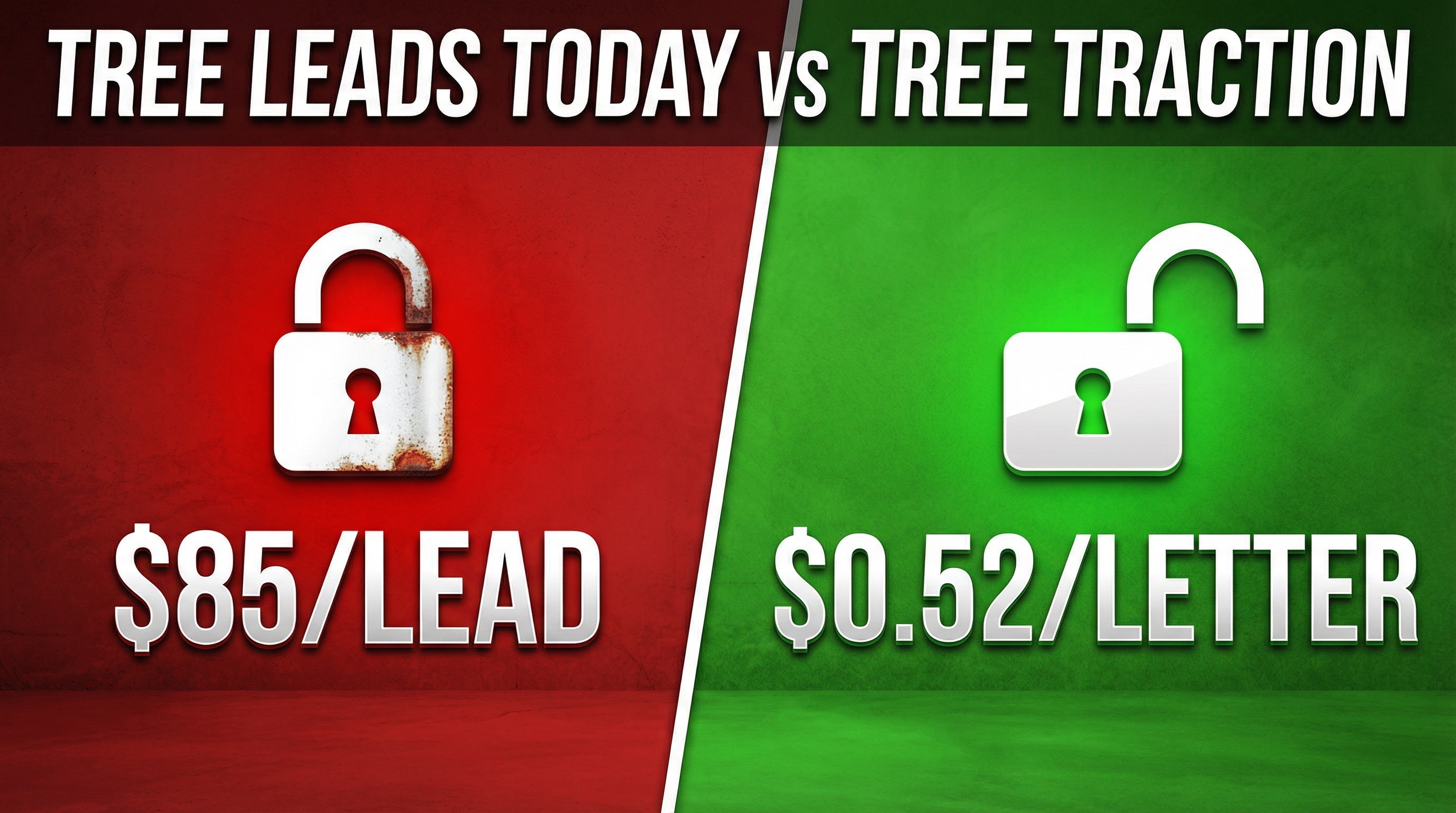
Tree Leads Today is a pay-per-call option for owners who want variable billing, while Tree Traction charges $0.52-$0.70 per letter for route-level control and data ownership. Choose based on whether you want to rent calls as they arrive or own the tracking numbers and route history behind a repeatable campaign.
Across 250+ tree service companies, we’ve seen the same ownership risk with pay-per-call direct mail: if the provider controls the tracking number and campaign data, the client can’t carry those assets forward when they leave. If you are comparing automation platforms, Dope Marketing and Tree Traction use very different service models.
That’s the core tension between Tree Leads Today and Tree Traction. Both do direct mail for tree service companies. Both generate real calls. But the models are fundamentally different, and which one makes sense for your business depends on what you’re actually building.
This side-by-side view isolates the decisions that affect cost control and long-term ownership.
| Decision factor | Tree Leads Today | Tree Traction |
|---|---|---|
| Billing unit | Pay per call, with rates varying by market | $0.52-$0.70 per letter |
| Route selection | Provider-controlled | Routes reviewed with the client using 295 data points each |
| Tracking number | Provider-controlled | Client-owned |
| Performance detail | Call delivery | Call attribution by carrier route |
| Optimization | Provider-managed | Weak routes cut and replacements tested |
| Best fit | Variable call purchasing | Managed, repeatable market development |
Tree Leads Today runs a pay-per-call model. They handle the mailing, own the tracking number, and charge you per inbound call. Tree service owners who have run their program tell us on sales calls that the rate lands around $85 per call, and it moves with the market. You don’t pick the routes. You don’t see the mailer before it goes out. You don’t know when mail drops. You just pay when the phone rings.
Tree Traction runs a per-piece model. You pay $0.52-$0.70 per letter depending on volume, with a Growth plan starting around $3,200/month for 4,600 letters across two mailings. You approve every route, every design, and every drop date. You own every tracking phone number. And your results are tracked at the individual carrier route level so your campaigns get better over time.
Same industry. Same channel. Completely different businesses.
Step back from the two brand names for a second, because plenty of owners land here typing “tree leads” without knowing there are four different products sold under that one phrase.
They are not variations of the same thing. They bill differently, they hand you different assets, and they fail differently.
| What’s for sale | How you’re billed | Who else gets the same call | What you own when you quit |
|---|---|---|---|
| Pay-per-call direct mail (Tree Leads Today) | Per inbound call | Nobody, zip codes are held exclusively | Nothing. The number and the call history stay with the provider |
| Shared marketplace (Angi, Thumbtack, Google LSA “Get Competitive Quotes”) | Per lead, often per form fill | Three to five tree services at once | Nothing, and the homeowner already has four other numbers |
| Per-piece managed mail (Tree Traction) | Per letter mailed | Nobody | Every tracking number, every route result, the whole campaign history |
| DIY EDDM | Printing plus postage, paid up front | Nobody | Your artwork, and no performance data to improve from |
Read down the last column, because that’s the column almost nobody reads before signing. Two of these four models hand you an asset. Two hand you a receipt.
The shared-marketplace row is its own argument, and we take it apart in alternatives to Angi, HomeAdvisor and Thumbtack for tree service leads. What a call should cost you in each model is in cost per lead benchmarks for a tree service. And “exclusive” turns out to mean two different things depending on who’s saying it, which exclusive tree service leads sorts out.
Vendor names in this category change. Tree Leads Today’s own domain now points somewhere else. So ask about mechanics instead of reputation, because mechanics survive a rebrand.
Question four is the one that separates a flat program from one that improves, and it’s worth understanding how route-level call tracking actually works before you accept zip-code reporting as normal.
Here’s where the comparison gets interesting. Tree Leads Today’s $85 per call sounds simple. But run the numbers on a busy month.
Say your mailer generates 30 calls. At $85 each, that’s $2,550. Now say 5 of those calls are referrals from previous customers who found your number on the mailer. You’re paying $85 for every single one of those referral calls too, because they’re dialing the tracking number Tree Leads Today owns.
Your neighbor loved your work. She tells her friend. Her friend calls the number on the mailer sitting on the kitchen counter. That’s $85.
With Tree Traction, you pay for the letters you mail. Period. Referrals, repeat calls, word-of-mouth callbacks, they’re all free. Your cost is locked in before the month starts. No surprises. No creeping bills.
A tree service owner running 30 calls per month through Tree Leads Today is spending $2,550 in call charges alone. That same owner on Tree Traction’s Growth plan is spending $3,200 total, including design, printing, targeting, postage, and route-level tracking on every single carrier route. And every referral call after that? Zero.
Which model gets more expensive as your reputation grows?
The pay-per-call pitch is that you only pay when the phone rings. True. The part that catches owners off guard is that a good month and a bad month cost wildly different amounts, and you find out after the fact.
Here’s the same three months under both models, using the roughly $85 per call rate owners describe to us and Tree Traction’s Growth plan at about $3,200 a month for 4,600 letters across two mailings.
| Calls that month | Tree Leads Today | Tree Traction Growth plan | What you own after |
|---|---|---|---|
| 15 (slow February) | About $1,275 | $3,200 | Nothing vs. every tracking number and route result |
| 30 (normal month) | About $2,550 | $3,200 | Nothing vs. every tracking number and route result |
| 55 (storm month) | About $4,675 | $3,200 | Nothing vs. every tracking number and route result |
Read the bottom row twice. The month your marketing works best is the month it costs the most, and the per-piece model doesn’t move at all. Your best month is supposed to be your most profitable month, not your most expensive one.
There’s a second cost that never shows on the invoice. Every referral call, every repeat customer, and every neighbor who dials the number off a letter still sitting on a kitchen counter bills you again, because that number isn’t yours.
Worth being straight about the evidence here: Tree Leads Today has no Trustpilot profile and no BBB review page, so there is no public star rating to point you at. What exists is 15 years of word of mouth, which cuts both ways.
The praise is consistent. They’ve been doing tree service direct mail longer than anyone, they hold zip codes exclusively, and plenty of companies have made real money with them. Their own page claims 800-plus customers, 97% retention and more than 400,000 calls generated a year, which are big numbers for this category and worth weighing. Those are self-reported and unaudited, same as any vendor’s.
Notice what that page does publish and what it doesn’t. It publishes volume and it publishes exclusivity, stating that “the zip codes you tell us to target for your company are your zip codes.” It doesn’t publish a price, and it doesn’t say who owns the phone number. Those two blanks are the whole decision.
The complaints are consistent too, and they cluster in three places. Zip code availability, where owners report waiting on markets that never open. Cost at scale, once call volume grows. And customer service, which comes up more than anything else in the conversations we have with owners who’ve left.
Zip availability is the one we hear about most often on sales calls: owners stuck in the two or three zip codes they could get, with no route into the neighborhoods next door.
If you’re shopping the wider category rather than just these two, we compare the platform options in alternatives to Angi, HomeAdvisor, and Thumbtack.
This is the part most tree service owners don’t think about until it’s too late.
With Tree Leads Today, they own the tracking phone number printed on your mailer. That number is tied to their system. If you cancel, you lose the number, the call history, and any momentum that number has built in your market. Homeowners who saved that number? They’re calling Tree Leads Today’s system now, not yours.
With Tree Traction, you own every phone number from day one. A typical client has 40-50 unique tracking numbers, one for each carrier route, all forwarding to your main line. If you leave, you port those numbers out for $1.25 each. Your call history, your route performance data, your campaign insights, they’re yours to keep.
That’s the difference between renting a marketing channel and building a marketing asset.
Here’s something most tree service owners don’t realize: 75% of your direct mail calls come from about 50% of the routes you’re mailing. That’s what we’ve found across 250+ tree service campaigns at Tree Traction.
That means half your routes are producing almost nothing. Every month.
Tree Traction assigns a unique tracking phone number to every single carrier route. So after your first mailing, you know exactly which neighborhoods generated calls and which ones wasted your money. Month two, you cut the dead routes and double down on the winners. Month three, your cost per lead drops again. That’s how direct mail compounds.
Tree Leads Today doesn’t offer route-level tracking. They don’t assign individual numbers per carrier route. You get calls, but you have no idea which specific neighborhoods are producing them. So there’s no feedback loop. No optimization. Results stay flat because there’s nothing to improve from.
Sound familiar? It’s the same problem as doing EDDM yourself, just at a higher price point.
Tree Leads Today uses the same standard letter format across their entire client base. You don’t choose the design. You don’t approve the messaging. You don’t see the mailer before it hits mailboxes. Multiple tree service owners we’ve spoken to on sales calls describe the letters as generic and stale.
Here’s why that matters. If you’re in a market where three other tree service companies also use Tree Leads Today, those homeowners are getting nearly identical letters from different companies. Your brand doesn’t stand out because it’s not really your brand on the mailer.
Tree Traction designs every mailer from scratch for each client. Full-size 8.5x11 handwritten-style letters, full color, sent flat via EDDM. Your photos. Your messaging. Your A/B tested creative. Your account manager sends you 3-4 design options, you pick what you like, and you collaborate on the final version. You approve everything before a single letter goes out.
Want to test a storm damage message in spring and a dormant pruning offer in winter? You can. Want to swap in a new crew photo or update your pricing? Done. That level of control doesn’t exist with Tree Leads Today.
Tree Leads Today’s main domain now redirects to pay4leads.com. The company was acquired by Liftout Capital and has expanded into roofing, windows, and siding leads through a new brand called Roof Leads Today.
What does that mean for you? It means tree service is no longer their only focus. When a company that built its reputation serving tree companies starts splitting attention across four different industries, the level of specialized knowledge and dedicated support tends to shift.
Tree Traction does one thing. Direct mail for tree service companies. That’s it. No roofing. No siding. No windows. Every data point, every design template, every targeting algorithm, every account manager’s expertise is built around getting tree service owners more calls from the right neighborhoods. When you call your account manager (who handles fewer than 20 accounts), they know the difference between a removal lead and a trim lead, they know which seasonal messaging works in your market, and they pick up the phone.
Let’s be honest. Tree Leads Today isn’t a bad product for everyone.
If you’re a newer tree service company that needs calls immediately with minimal upfront risk, their pay-per-call model removes the guesswork. You don’t pay until the phone rings. For a company in its first year still figuring out its service area and close rate, that’s a real advantage.
If you only need leads for a month or two (maybe you’re filling a seasonal gap and don’t want a monthly commitment), the short-term flexibility works.
But here’s the tradeoff. You’re paying more per lead over time. You’re building nothing you own. You have zero visibility into what’s working. And the better your reputation gets (the more referrals, the more repeat calls), the more it costs you.
For a tree service company doing $750K+ with two or more crews, that model stops making sense fast.
Tree Traction is built for tree service companies that are past the survival phase and ready to build something. You’re running crews. You’re closing jobs. You want to know which neighborhoods are producing, own the data your marketing generates, and see your cost per lead drop month over month instead of staying flat.
Targeting uses 295 data points per carrier route, including satellite tree density analysis that nobody else in the country has, so your letters land in yards that actually have trees worth removing. That’s also why calls arrive in the same neighborhoods instead of scattered across the county.
Alissa Tooley with A&J Specialties quoted $160,800 in 3 months and closed $69,200. She didn’t get those results by hoping the right neighborhoods got mailed. She got them because every route was tracked, underperformers were cut, and winners were scaled.
That’s the compounding effect. And it only works when you have data. For context on what any of this should produce, ANA/DMA’s 2025 Response Rate Report puts the average direct mail response rate at 4.4%, and we break down what that means for tree service specifically in what’s a good direct mail response rate.
Tree Leads Today is renting. You pay per call, you don’t own the number, you don’t see the data, and if you leave, you start from zero. For brand-new companies, renting makes sense. Low risk, immediate calls, no commitment.
Tree Traction is owning. You pay per piece, you own every number, you see every data point, and everything you build stays with you. For established tree service companies ready to invest in a system that gets smarter over time, ownership wins.
The question isn’t which company is “better.” It’s which model matches where your business is right now and where you’re trying to go.
If you’re building a tree service company that doesn’t depend on you climbing every day, if you want to hire crews and manage instead of hustle, you need marketing you own. Not marketing you rent.
See which routes make sense in your area. We’ll map it out for free.
Ready to grow into the neighborhoods you want?
250+ tree companies use Tree Traction. See if your zip code is available.
Book a Free Strategy CallFREQUENTLY ASKED QUESTIONS
Tree Leads Today charges approximately $85 per inbound call. Because they bill per call rather than per piece mailed, your monthly cost fluctuates based on volume. A busy month could mean a surprise $2,400 bill when you were expecting $800. Tree Traction charges a flat per-piece rate ($0.52-$0.70), so you know your exact spend before the month starts.
No. Tree Leads Today owns the tracking phone number on your mailer. If you cancel, that number and all the call history attached to it stays with them. With Tree Traction, you own every tracking number and can port them out anytime for $1.25 per number.
If you're brand new and need calls immediately with minimal upfront spend, Tree Leads Today's pay-per-call model has a lower barrier to entry. But once you're past the startup phase and running crews, a per-piece model like Tree Traction gives you predictable costs, data ownership, and results that improve month over month.
No. Tree Leads Today uses a standard letter format across all clients. You don't choose the messaging, the design, or the timing. With Tree Traction, every mailer is custom-designed for your company. You approve routes, creative, and drop dates before anything goes out.
Tree Leads Today's domain now redirects to pay4leads.com following an acquisition by Liftout Capital. The company has expanded into roofing, windows, and siding leads. This shift means tree service is no longer their sole focus, which may affect the level of industry-specific expertise and attention clients receive.
About the Author
Brayden Fielding
CEO, Tree Traction
Brayden Fielding is the founder and CEO of Tree Traction, the only direct mail company in the U.S. built exclusively for tree service businesses. He's worked with 250+ tree service companies across the country, studying what makes direct mail campaigns produce real revenue (and what makes them flop). When he's not digging into route-level data or reviewing campaign results, he's talking to tree service owners about what's actually working in their markets.
KEEP READING
Out-of-town storm chasers flood your market after every big blow. Here is how a local tree service wins those storm leads on trust, speed, and timing.
AI search is how homeowners find contractors now. What ChatGPT reads before it names a tree service, and the trust signals worth fixing this month.
A tree service keywords guide built on real 2026 cost-per-click data: what each search term is worth, what it actually books, and where it belongs.
Book a free strategy call — 30 minutes, no obligation.
Book a Free Strategy Call